Entrepreneurship and Building Future Civilization: Research and Development (3)
In his third article, Economic Analyst Ali Faqeeh looks at Singapore’s R&D phases in legislation and innovations, the benefits of this process, and the amount the state invests compared to its exponential returns.
Military Technology: A New Formula for Conflicts
Dr. Ashraf Keshk presents his remarks on countries’ need to qualify their local experts in military industrialization, in line with international cooperation to prevent rogue states and groupings from acquiring advanced materiel. He refers to large events organized by the Kingdom of Bahrain to discuss and demonstrate the latest developments in this area, quoting expert opinions that support proceeding down this path.
In an extensive poll conducted by Derasat on the upcoming elections Dr. Shaikh Abdullah bin Ahmed Al Khalifa: The results of the national survey confirm the high participation rate in the electoral process and optimism about the future of the democratic process
Dr. Shaikh Abdulla bin Ahmed Al Khalifa, Chairman of the Board of Trustees of the Bahrain Center for Strategic, International and Energy Studies (Derasat), stated that the results of the national survey conducted by the Center on the parliamentary and municipal elections, scheduled to be held on November 12, showed great popular keenness to participate in the democratic entitlement, and wide interaction to exercise the constitutional right to manage public affairs in light of full conviction of the transparency and integrity of the electoral process, and the availability of all the ingredients and procedures established. He pointed out that the Kingdom of Bahrain will witness an exceptional event that presents a successful, integrated and sustainable model for a free and responsible democratic life, and reflects the honorable civilized image of the people of Bahrain, and their keenness to protect national gains, and build on the consolidation of constitutional institutions and the rule of law.
NATO and the Iran-Deterrence Policy
In this article, Dr. Ashraf Keshk assesses NATO’s warnings about Iran’s drones and missiles being used against Ukraine, comparing these warnings with the previous leniency demonstrated during the lengthy and futile negotiations by the 5+1 countries on Iran’s nuclear portfolio, while pointing out the opportunities to develop the defense partnership with Gulf States considering this dangerous development and NATO States’ need for Gulf energy security.
Entrepreneurship and Building Future Civilization: Education (2)
In the second part, Economic Analyst Ali Faqeeh identifies five factors that ensured the success of education in Singapore: socioeconomic drivers, effective educational policies, quality curricula, teacher independence, and quality teacher training.
Maritime Security of the Arabian Gulf States – Analysis of Current Threats, Confrontation Mechanisms, and Future Challenges
The book focuses on the most prominent maritime security threats to the Arab Gulf states and includes four chapters. The first chapter deals with the concept and dimensions of maritime security while determining the legal status of the Straits of Hormuz and Bab al-Mandab and provides a historical analytical overview of the tanker war that took place in the Arabian Gulf region during the Iran-Iraq war in the eighties of the last century.
Derasat Center launches two new books on the NATO-GCC Strategic Partnership and Naval Security Threats
In its mission to spread knowledge and awareness of strategic Arabian Gulf-related issues, the Bahrain Center for Strategic, International and Energy Studies (Derasat) published two new books, “Nato and the Arabian Gulf Countries: An Analysis of the Fifteen Year Strategic Partnership”, and “Maritime Security of the Arabian Gulf States – Analysis of Current Threats, Confrontation Mechanisms, and Future Challenges”, written by Dr. Ashraf Mohammed Keshk, Director of the Strategic and International Studies Program at Derasat’s Directorate of Studies and Research.
NATO and the Arabian Gulf Countries: An Analysis of the Fifteen Year Strategic Partnership
The book includes four chapters. The first chapter deals with the analysis of the emergence of NATO in 1949, and the nature of that alliance through the analysis of its structure and the evolution of its roles, while the second chapter deals with the content of the Istanbul Cooperation Initiative in 2004, which includes six areas of security and defense cooperation between NATO and four countries from the Arabian Gulf, including the Kingdom of Bahrain.
Derasat-UNDP research papers analyze COVID-19 challenges to Bahraini Women
Two research papers, jointly prepared by the Bahrain Center for Strategic, International and Energy Studies (Derasat) and the United Nations Development Programme (UNDP) on the COVID-19 pandemic’s challenges to Bahraini women, recommended accounting for women’s diverse experiences and needs, away from a unified mold shared with men.
The Impact of COVID-19 on Women in Bahrain
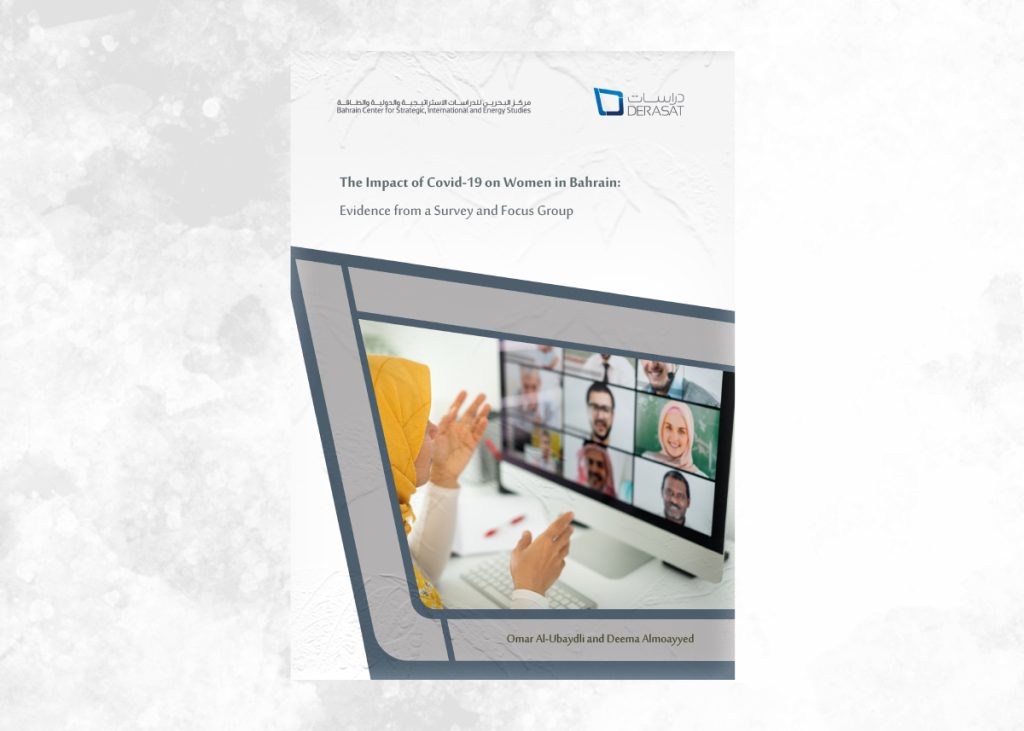
Derasat Center and the United Nations Development Programme published two research papers titled, “The Impact of COVID-19 on Women in Bahrain”, and “Bahraini Women and Remote Work”; prepared by Dr. Omar Ahmed Al-Ubaydli, Derasat Director of Studies and Research, and Ms. Deema Al-Moayyed, UNDP researcher.