Venezuela’s Crisis: Lessons for the GCC
The period following WW2 witnessed the emergence of a military conflict between American and the Soviet union. The capitalist and socialist-communist economic models also crossed swords as a subplot of this global conflict, and the…
Why Rents Can Be Slow to Fall in the UAE and Elsewhere
Markets are complex, and consumers often struggle to understand pricing decisions, resorting to conspiracy theories. For example, in countries with floating petrol prices – the UAE is a new member of this club after subsidy reforms – consumers are convinced that…
Derasat Journal 2015 – Issue 2
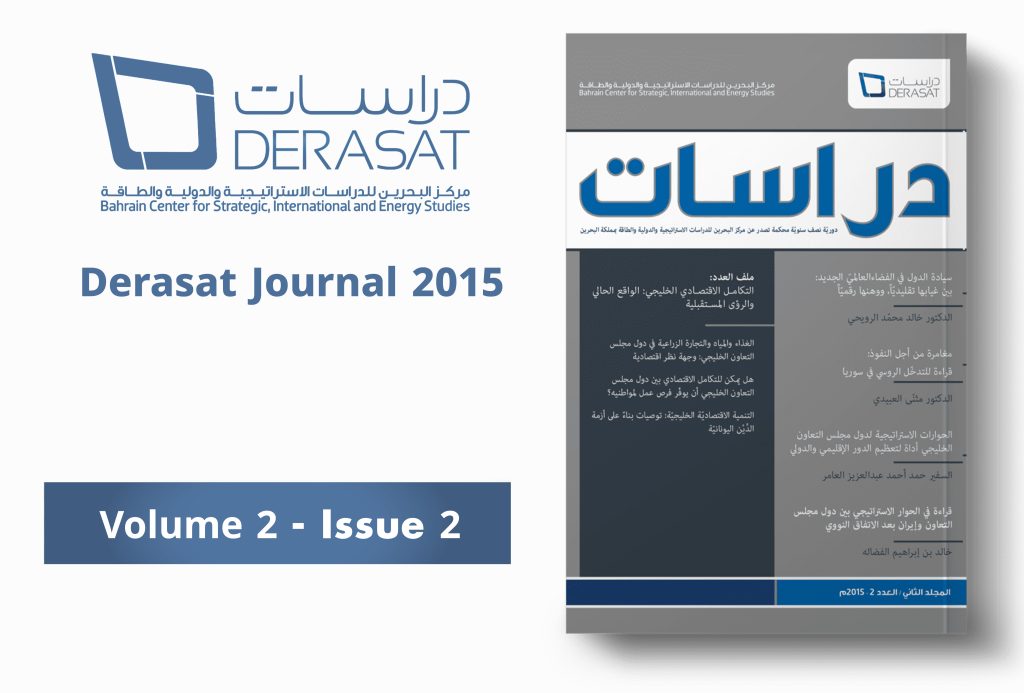
A semi-annual specialized journal issued by the Bahrain Center for Strategic, International and Energy Studies in the Kingdom of Bahrain. The journal aims to public studies and reports on political, international, economic, security, energy, and cyberspace issues that relate to strategic issues…
Time for the GCC to Leave OPEC
For Saudi Arabia and the remaining Gulf Cooperation Council (GCC) countries (Bahrain, Kuwait, Oman, Qatar and United Arab Emirates), which together account for around 40 percent of the world’s oil reserves and the lion’s share of OPEC’s collective output, their future oil strategy should be an exclusively GCC affair, away from the stress and dysfunction of OPEC.
Arab-GCC Integration: the Need to Realize Regional Power Balance
Why Behavioral Biases Increase the Pain of Subsidy Cuts
Subsidies in the GCC are a tradition that is particularly difficult to justify, and Twain’s maxim has likely underlain some of the challenges faced by the Gulf governments as they have tried to scale back subsidies. Biases in the way that humans think present additional obstacles to reform.
The GCC Countries and Yemen: a Future Vision for Regional Security
Uberizing Saudi Arabia
This is the Thatcher revolution for Saudi Arabia?,” is the question that The Economist recently posed to Deputy Crown Prince Muhammad Bin Salman, regarding his comprehensive economic reform plan…
Exporting Traditional Foods: an Alternative Means of Diversifying the GCC Economy
The governments of the Gulf Cooperation Council (GCC) states have long been searching for the best way to diversify their economies, and in the wake of falling oil prices, they have accelerated their search.
The Fraying of the International Alliance System
When it comes to the Middle East, a former boss of mine once told me “conspiracy theories, are a regional sport”. This to be fair, is still true today, although it has become increasingly hard to counter the tall tales pushed by these enthusiastic theorists.