

This paper examines an important regional development represented by the evolution of the Gulf role toward Iraq, reflecting growing Gulf awareness of Iraq’s importance for the security of the Arabian Gulf and regional security in general. At the same time, this shift in the Gulf position stemmed from the Gulf states’ perception of changes in the policies of the Iraqi ruling elite toward issues concerning the Gulf Cooperation Council (GCC) states.
The paper provides a comprehensive analysis of the political, economic, and security challenges facing Iraq at the present time, in addition to presenting an extensive review of GCC summit statements accompanied by an important analysis of the nature of this transformation and the reasons behind it. The study argues that the relationship between the two sides has historically been shaped by differing perceptions of interests across various periods, creating opportunities at times and imposing constraints at others on the natural development of these relations.
The paper also offers a detailed analysis of Gulf perceptions toward Iraq and explains how the restoration of relations with Iraq occurred gradually and why this gradual approach was adopted. The study concludes that supporting the construction of the Iraqi national state represents the best strategic option for the GCC states, enabling Iraq to contribute effectively to Gulf and regional security while overcoming the legacies and tensions of previous periods that continue to re-emerge from time to time and require further efforts from both the Gulf states and Iraq itself to resolve.
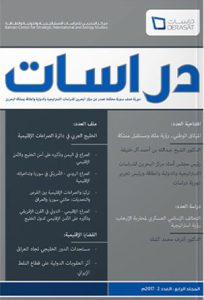
Derasat Journal 2017 – Issue 2
- The Derasat Journal aims to publish rigorous studies on issues related to the Arabian Gulf region, neighboring countries, the Middle East, and the world, particularly with regard to security and defense, economics and energy, from a comprehensive strategic perspective.
- To establish an intellectual dialogue among researchers from the Arabian Gulf region and beyond concerning current challenges and ways to address them.
- To enrich knowledge regarding the Arabian Gulf region and issues of regional and global security.
- Submitted studies must demonstrate originality and provide the journal with “added value,” away from repeating traditional topics, particularly in light of the rapid developments taking place in the region and the world.
- Studies submitted for publication should be relevant to issues concerning the Kingdom of Bahrain and the Gulf states, in addition to regional and international issues that have implications for the Gulf region.
- Submitted studies must maintain objectivity and avoid offending individuals, states, religions, or cultures.
- Studies submitted for publication must not have been previously published elsewhere, whether in print or electronically. The journal retains all intellectual property rights. Therefore, the contributor’s receipt of these conditions along with the assignment email implicitly signifies acceptance of them, and accordingly, the author may not republish material published in the journal elsewhere by any print or electronic means.
- Studies submitted for publication must adhere to recognized academic standards, whether regarding scientific methodology or citation and referencing. The journal follows the Chicago style for references and accepts submissions in both Arabic and English.
- The length of studies submitted for publication should range between 6,000–7,000 words, while book reviews and strategic report reviews should range between 1,500–2,000 words.
The themes of each issue of the journal are announced on the journal’s website at the Bahrain Center for Strategic, International and Energy Studies (DERASAT), inviting submissions related to those themes. Proposals for study ideas are received and discussed by the journal’s Editorial Board, after which the contributor is informed of the Board’s decision. In addition, the Editor-in-Chief may commission certain researchers to prepare studies in line with the journal’s work plan.
- No studies are published in the journal unless approved by the Peer-Review Committee (consisting of two reviewers), which has the authority to accept, reject, or request revisions from the author. The Editor-in-Chief informs the author of the reviewers’ final decision.
- Peer review is conducted by submitting the study without reference to the author’s name, accompanied by the peer-review form published on the journal’s website at the Derasat Center. The form includes four academic criteria: relevance and scope, originality and contribution, theoretical and analytical dimensions, and structure and clarity, in addition to any further comments the reviewer may wish to provide.
- A diverse list of reviewers from various specializations is selected in accordance with the objectives of the journal and the nature of the studies published therein.
Editor-in-Chief
- H.E. Dr. Shaikh Abdulla bin Ahmed bin Abdulla Al Khalifa
Chairman of the Board of Trustees Bahrain Center for Strategic, International and Energy Studies (Derasat) Kingdom of Bahrain
Managing Editor
- Dr. Ashraf Mohammed Keshk
Director of the International and Strategic Studies Program Bahrain Center for Strategic, International and Energy Studies (DERASAT) Kingdom of Bahrain
Dr. Ashraf Mohamed Keshk is a Senior Strategic Studies Expert specializing in Gulf and regional security, with more than three decades of research and academic experience. He received his PhD in Political Science from Cairo University in 2009, with a dissertation on the development of Gulf regional security since 2003: Study on the Impact of NATO Strategy,, which was awarded Best PhD Thesis. In the same year, he obtained a Diploma in Defense Studies from the NATO Defense College in Rome.
He has worked at the Bahrain Center for Strategic, International and Energy Studies (Derasat) since 2012 and currently serves as Director of the Program of Strategic and International Studies. His expertise focuses on Gulf security, defense policies, maritime security, and crisis management. He also served as an Academic Mentor and Lecturer at the NATO Defense College from 2009 to 2018 and has participated extensively in international academic, training, and conference activities.
Dr. Keshk has published extensively on Gulf and regional security. His major books include The Development of Gulf Regional Security since 2003: Study on the Impact of NATO Strategy,, Western Policies Toward the Security of the Arabian Gulf, NATO and the Gulf Countries (Springer, 2021), Maritime Security of the Arab Gulf States (Springer, 2022), and Security and Defense Policies of the Arabian Gulf Countries (2024). He also co-edited Gulf Cooperation Council Achievements and Challenges in 2025.
Associate Editors
- Omar Al-Ubaydli
Studies and Research Director
Bahrain Center for Strategic, International and Energy Studies (DERASAT), Bahrain
- Dr. Abdullah Al-Abbasi
Director of the Energy and Environment Program
Bahrain Center for Strategic, International and Energy Studies (DERASAT), Bahrain
Members
- Dr. Christian Koch
Executive Manager, Gulf Research Center Foundation Brussels and Director of Research
Gulf Research Center Kingdom of Belgium/ Kingdom of Saudi Arabia
- Dr. Osamah Alsayeghi
Research Scientist
Kuwait Institute for Scientific Research (KISR) Nonresident Scholar, Rice University’s Baker Institute for Public Policy State of Kuwait
- Dr. Moataz Salama
Director, Arabian Gulf Program and Head of the Arab and Regional Studies Unit
Al-Ahram Center for Political and Strategic Studies Arab Republic of Egypt
- Dr. Athraa Sayed Abbas Al-Mosawi
Dean of Graduate Studies & Scientific Research, University of Bahrain
Member of the Board of Trustees, Bahrain Center for Strategic, International and Energy Studies (Derasat) Kingdom of Bahrain
Derasat Journal 2/2017 focuses on a number of topics related to Gulf regional security in the light of current developments and Gulf-American relations.
Recent Developments in the Gulf Role toward Iraq and Its Importance for Gulf and Regional Security
The Conflict in Yemen and Its Implications for Gulf and Regional Security
This paper seeks to examine the particular nature of the conflict in Yemen, identify its main characteristics, and distinguish it from other conflicts within the Arab region. It also explores the expected future trajectories of the current Yemeni situation, in addition to the impact of the future of the conflict—or the Yemeni crisis—on the security of other Arab states, particularly the Gulf Cooperation Council (GCC) states, in both the short and long term. The study further examines the effect of the Yemeni crisis on the regional security system as a whole, especially its influence on the course of the Gulf-Iranian conflict.
The paper concludes with several findings, most notably that Yemen’s economic situation is extremely dangerous, as Yemen remains the poorest Arab country and records one of the highest poverty rates in the region. These factors represent important indicators in measuring the strength of both the state and society. The study also argues that the continuation of the Houthi alliance, which controls many state institutions and strategic positions in Yemen, could lead to the emergence of a new Yemeni entity representing a challenge to Gulf security.
The paper concludes with several findings, most notably that Yemen’s economic situation is extremely dangerous, as Yemen remains the poorest Arab country and records one of the highest poverty rates in the region. These factors represent important indicators in measuring the strength of both the state and society. The study also argues that the continuation of the Houthi alliance, which controls many state institutions and strategic positions in Yemen, could lead to the emergence of a new Yemeni entity representing a challenge to Gulf security.
The Impact of International Sanctions on the Iranian Oil Sector
This paper examines the background of the sanctions imposed on the Iranian oil sector, particularly from 2012 until 2015, the year that witnessed the signing of the nuclear agreement between Iran and the P5+1 countries. The paper also discusses the consequences of the agreement regarding the lifting of sanctions imposed on Iran, while noting that sanctions unrelated to Iran’s nuclear program—particularly those connected to human rights issues and support for terrorism—remained in place.
The study further addresses Iran’s attempts to attract foreign investment and the obstacles hindering these efforts, in addition to highlighting the possible economic consequences that could result from the reimposition of sanctions on Iran in the event of violations of the nuclear agreement.
The study further addresses Iran’s attempts to attract foreign investment and the obstacles hindering these efforts, in addition to highlighting the possible economic consequences that could result from the reimposition of sanctions on Iran in the event of violations of the nuclear agreement.
The Islamic Military Alliance to Combat Terrorism: A Strategic Vision
This study addresses an analysis of the decision of the Kingdom of Saudi Arabia to establish the Islamic Military Alliance to Combat Terrorism in December 2015, considering it an important Gulf and regional development to confront that challenge on the one hand, and an indicator of the development of regional security itself on the other hand. The study includes four main conclusions:
First: the nature of that alliance and its legal basis.
Second: the strategic importance of establishing that alliance.
Third: the extent of the effectiveness of that alliance in confronting the phenomenon of terrorism.
Fourth: the requirements for activating the work of that alliance.
The study concluded with several findings, namely that although the Islamic Alliance is not classified among the traditional defensive alliances witnessed by the world, including the North Atlantic Treaty Organization “NATO,” it nevertheless included mechanisms of action similar to the essence of the work of those alliances. The Islamic Alliance also acquires a particular character in this regard, considering that most of its efforts will be within Islamic states, which have witnessed most terrorist incidents compared with other countries of the world. In addition, the presence of forty-one states within this alliance under the leadership of the Kingdom of Saudi Arabia, which possesses extended experience in confronting terrorism—along with its regional and international weight, and the support this alliance enjoys from the international community—all constitute elements supporting the work of that alliance.
The study further concludes that the continuity of alliances remains linked to the objective for which they were established, in addition to their close connection with regional and international balances of power. Some of these alliances may also endure if there exists a founding charter that includes a clear structure containing defined commitments by member states, in addition to the importance of having future strategies for such alliances in order to adapt and adjust to the environment of changing security threats.
First: the nature of that alliance and its legal basis.
Second: the strategic importance of establishing that alliance.
Third: the extent of the effectiveness of that alliance in confronting the phenomenon of terrorism.
Fourth: the requirements for activating the work of that alliance.
The study concluded with several findings, namely that although the Islamic Alliance is not classified among the traditional defensive alliances witnessed by the world, including the North Atlantic Treaty Organization “NATO,” it nevertheless included mechanisms of action similar to the essence of the work of those alliances. The Islamic Alliance also acquires a particular character in this regard, considering that most of its efforts will be within Islamic states, which have witnessed most terrorist incidents compared with other countries of the world. In addition, the presence of forty-one states within this alliance under the leadership of the Kingdom of Saudi Arabia, which possesses extended experience in confronting terrorism—along with its regional and international weight, and the support this alliance enjoys from the international community—all constitute elements supporting the work of that alliance.
The study further concludes that the continuity of alliances remains linked to the objective for which they were established, in addition to their close connection with regional and international balances of power. Some of these alliances may also endure if there exists a founding charter that includes a clear structure containing defined commitments by member states, in addition to the importance of having future strategies for such alliances in order to adapt and adjust to the environment of changing security threats.
The Regional and International Conflict in the Horn of Africa and Its Impact on Gulf Regional Security
This paper seeks to examine the current and future dimensions of the regional and international conflict in the Horn of Africa and to clarify the impact of this conflict on the regional security of the Gulf states. The study is structured around three main themes. The first addresses the map of regional and international powers competing in the Horn of Africa and their respective interests. The second examines the impact of these conflicts on the regional security of the Gulf states in particular. The third discusses the options available to the Gulf states in dealing with the opportunities and challenges resulting from these conflicts.
The paper concludes with several recommendations for the Gulf states, including the need to define priorities and objectives for Gulf engagement in the Horn of Africa, adopt a unified Gulf and Arab economic and investment strategy toward the region’s challenges, and confront extremism, violence, and armed terrorism decisively through a combination of security, economic, and political reform initiatives.
The study also recommends efforts to resolve border and regional disputes among the states of the Horn of Africa, strengthen the physical presence of Gulf forces in coordination with regional and international actors, establish modern databases to assess the risks of irregular migration from the Horn of Africa to the Gulf states, and seriously consider organizing a regular Gulf-African summit bringing together leaders of both regions alongside economic and intellectual forums aimed at enhancing cooperation and maximizing mutual benefits across various sectors.
The paper concludes with several recommendations for the Gulf states, including the need to define priorities and objectives for Gulf engagement in the Horn of Africa, adopt a unified Gulf and Arab economic and investment strategy toward the region’s challenges, and confront extremism, violence, and armed terrorism decisively through a combination of security, economic, and political reform initiatives.
The study also recommends efforts to resolve border and regional disputes among the states of the Horn of Africa, strengthen the physical presence of Gulf forces in coordination with regional and international actors, establish modern databases to assess the risks of irregular migration from the Horn of Africa to the Gulf states, and seriously consider organizing a regular Gulf-African summit bringing together leaders of both regions alongside economic and intellectual forums aimed at enhancing cooperation and maximizing mutual benefits across various sectors.
The Russian-American Conflict in Syria and Its Impact on Regional Security
This paper examines the Russian-American conflict in Syria by identifying the interests of both parties in the crisis and the mechanisms through which they defend those interests, as well as the areas where these interests converge or intersect. The study also addresses the determinants of this conflict, which are linked not only to the Syrian crisis itself, but also to broader issues such as the Ukrainian crisis and Russia’s confrontation with the North Atlantic Treaty Organization (NATO), of which the United States is the principal member.
The paper concludes with several findings, most importantly that the Russian-American rivalry in the region and beyond is expected to continue in the future, with the Middle East remaining a major arena of competition. The issue of the American military presence in Syria will continue to represent a significant source of debate and confrontation between the two countries. The study further argues that the Syrian crisis will remain a decisive battleground between Russia and the United States, one that will largely shape the future of the international order as well as the structure of global power and alliances.
The paper concludes with several findings, most importantly that the Russian-American rivalry in the region and beyond is expected to continue in the future, with the Middle East remaining a major arena of competition. The issue of the American military presence in Syria will continue to represent a significant source of debate and confrontation between the two countries. The study further argues that the Syrian crisis will remain a decisive battleground between Russia and the United States, one that will largely shape the future of the international order as well as the structure of global power and alliances.
The Turkish Vision of the Regional Conflict: Syria and Iraq
There are numerous historical, political, and social factors that have influenced the course of Turkish-Syrian-Iraqi relations, including geographical proximity and its implications, security concerns and their extensions, as well as the nature of regional alliances and their impact on decision-making centers in Ankara, Damascus, and Baghdad. Turkey, whose strategy toward both Syria and Iraq is examined in this paper, continues to bear significant losses and consequences resulting from regional crises and developments in both countries. Perhaps the greatest cost borne by Ankara has been the diversion of the gains achieved through its policies in Syria and Iraq to the benefit of other actors, while paving the way for regional and international powers such as Iran, Israel, Russia, and the United States to exploit these circumstances and achieve political, military, and economic influence at the expense of the three states.
The paper addresses three main issues: the factors shaping Turkey’s regional vision and its determinants in general; the Turkish perception of the crises in Syria and Iraq, including the substance of this vision and the factors influencing it; and finally the mutual interaction between Turkey and the broader regional security system.
The study argues that many observers of developments within the triangle of Turkish-Syrian-Iraqi relations believe that Turkey has lost, over the past decade, many of its political, economic, and strategic investment opportunities in Syria and Iraq. This has been attributed partly to the inability to define clear positions and choices regarding the internal affairs of both countries, and partly to the confused and ambiguous system of regional alliances surrounding regional developments. As a result, Turkey gradually shifted its Syrian and Iraqi policies from a soft-power model toward a harder approach, while slogans of openness to all parties and regional stability rapidly declined.
The paper addresses three main issues: the factors shaping Turkey’s regional vision and its determinants in general; the Turkish perception of the crises in Syria and Iraq, including the substance of this vision and the factors influencing it; and finally the mutual interaction between Turkey and the broader regional security system.
The study argues that many observers of developments within the triangle of Turkish-Syrian-Iraqi relations believe that Turkey has lost, over the past decade, many of its political, economic, and strategic investment opportunities in Syria and Iraq. This has been attributed partly to the inability to define clear positions and choices regarding the internal affairs of both countries, and partly to the confused and ambiguous system of regional alliances surrounding regional developments. As a result, Turkey gradually shifted its Syrian and Iraqi policies from a soft-power model toward a harder approach, while slogans of openness to all parties and regional stability rapidly declined.

