

This study aims to analyze one of the economic dimensions of the regional and international policies of the Arab Gulf states, which is the development of the issue of renewable energy. It is one of the strategic options for those countries, not only to support sustainable development plans, which among its objectives is to diversify sources of income, but also to fit international trends calling for the reduction of carbon emissions. The three parts of the study are integrated together; plans, challenges, and prospects to provide a comprehensive analysis of this issue.
The study concluded three main results:
First: The close link between the path of the Arab Gulf states towards developing the renewable energy sector and sustainable development plans, and with the presence of disparity between these countries in this regard, there is great interest in employing scientific research to reach better performance rates similar to other countries.
Second: Despite the importance of the efforts made by the Arab Gulf states to develop the renewable energy sector, they still face a number of challenges namely, institutional and market challenges, in addition to technical and social challenges. However, the Arab Gulf states, with their advantages, are promising countries in achieving high performance rates in the field of renewable energy, whether in terms of the abundance of sources of that energy or the success in establishing networks for electrical interconnections amongst themselves or with regional parties.
Third: Despite the small size of the investments of the Arab Gulf states in the field of renewable energy compared to other countries of the world, it is expected that they will double in the future. This is evident from the huge projects that these countries are currently working on the one hand, and their efforts in benefiting from the experiences of similar countries on the other hand. Moreover, the Arab Gulf States try to benefit from their international partnerships to enhance their capabilities in the field of renewable energy.
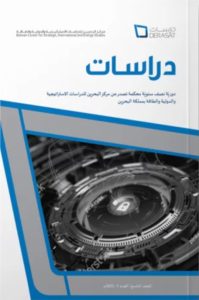
Derasat Journal 2022- Issue 1
- The Derasat Journal aims to publish rigorous studies on issues related to the Arabian Gulf region, neighboring countries, the Middle East, and the world, particularly with regard to security and defense, economics and energy, from a comprehensive strategic perspective.
- To establish an intellectual dialogue among researchers from the Arabian Gulf region and beyond concerning current challenges and ways to address them.
- To enrich knowledge regarding the Arabian Gulf region and issues of regional and global security.
- Submitted studies must demonstrate originality and provide the journal with “added value,” away from repeating traditional topics, particularly in light of the rapid developments taking place in the region and the world.
- Studies submitted for publication should be relevant to issues concerning the Kingdom of Bahrain and the Gulf states, in addition to regional and international issues that have implications for the Gulf region.
- Submitted studies must maintain objectivity and avoid offending individuals, states, religions, or cultures.
- Studies submitted for publication must not have been previously published elsewhere, whether in print or electronically. The journal retains all intellectual property rights. Therefore, the contributor’s receipt of these conditions along with the assignment email implicitly signifies acceptance of them, and accordingly, the author may not republish material published in the journal elsewhere by any print or electronic means.
- Studies submitted for publication must adhere to recognized academic standards, whether regarding scientific methodology or citation and referencing. The journal follows the Chicago style for references and accepts submissions in both Arabic and English.
- The length of studies submitted for publication should range between 6,000–7,000 words, while book reviews and strategic report reviews should range between 1,500–2,000 words.
The themes of each issue of the journal are announced on the journal’s website at the Bahrain Center for Strategic, International and Energy Studies (DERASAT), inviting submissions related to those themes. Proposals for study ideas are received and discussed by the journal’s Editorial Board, after which the contributor is informed of the Board’s decision. In addition, the Editor-in-Chief may commission certain researchers to prepare studies in line with the journal’s work plan.
- No studies are published in the journal unless approved by the Peer-Review Committee (consisting of two reviewers), which has the authority to accept, reject, or request revisions from the author. The Editor-in-Chief informs the author of the reviewers’ final decision.
- Peer review is conducted by submitting the study without reference to the author’s name, accompanied by the peer-review form published on the journal’s website at the Derasat Center. The form includes four academic criteria: relevance and scope, originality and contribution, theoretical and analytical dimensions, and structure and clarity, in addition to any further comments the reviewer may wish to provide.
- A diverse list of reviewers from various specializations is selected in accordance with the objectives of the journal and the nature of the studies published therein.
Editor-in-Chief
- H.E. Dr. Shaikh Abdulla bin Ahmed bin Abdulla Al Khalifa
Chairman of the Board of Trustees Bahrain Center for Strategic, International and Energy Studies (Derasat) Kingdom of Bahrain
Managing Editor
- Dr. Ashraf Mohammed Keshk
Director of the International and Strategic Studies Program Bahrain Center for Strategic, International and Energy Studies (DERASAT) Kingdom of Bahrain
Dr. Ashraf Mohamed Keshk is a Senior Strategic Studies Expert specializing in Gulf and regional security, with more than three decades of research and academic experience. He received his PhD in Political Science from Cairo University in 2009, with a dissertation on the development of Gulf regional security since 2003: Study on the Impact of NATO Strategy,, which was awarded Best PhD Thesis. In the same year, he obtained a Diploma in Defense Studies from the NATO Defense College in Rome.
He has worked at the Bahrain Center for Strategic, International and Energy Studies (Derasat) since 2012 and currently serves as Director of the Program of Strategic and International Studies. His expertise focuses on Gulf security, defense policies, maritime security, and crisis management. He also served as an Academic Mentor and Lecturer at the NATO Defense College from 2009 to 2018 and has participated extensively in international academic, training, and conference activities.
Dr. Keshk has published extensively on Gulf and regional security. His major books include The Development of Gulf Regional Security since 2003: Study on the Impact of NATO Strategy,, Western Policies Toward the Security of the Arabian Gulf, NATO and the Gulf Countries (Springer, 2021), Maritime Security of the Arab Gulf States (Springer, 2022), and Security and Defense Policies of the Arabian Gulf Countries (2024). He also co-edited Gulf Cooperation Council Achievements and Challenges in 2025.
Associate Editors
- Omar Al-Ubaydli
Studies and Research Director
Bahrain Center for Strategic, International and Energy Studies (DERASAT), Bahrain
- Dr. Abdullah Al-Abbasi
Director of the Energy and Environment Program
Bahrain Center for Strategic, International and Energy Studies (DERASAT), Bahrain
Members
- Dr. Christian Koch
Executive Manager, Gulf Research Center Foundation Brussels and Director of Research
Gulf Research Center Kingdom of Belgium/ Kingdom of Saudi Arabia
- Dr. Osamah Alsayeghi
Research Scientist
Kuwait Institute for Scientific Research (KISR) Nonresident Scholar, Rice University’s Baker Institute for Public Policy State of Kuwait
- Dr. Moataz Salama
Director, Arabian Gulf Program and Head of the Arab and Regional Studies Unit
Al-Ahram Center for Political and Strategic Studies Arab Republic of Egypt
- Dr. Athraa Sayed Abbas Al-Mosawi
Dean of Graduate Studies & Scientific Research, University of Bahrain
Member of the Board of Trustees, Bahrain Center for Strategic, International and Energy Studies (Derasat) Kingdom of Bahrain
The Bahrain Center for Strategic, International and Energy Studies (Derasat) published a new issue of Derasat Journal, its biannual peer-reviewed scientific journal, which examined several strategic issues and developments in the Arabian Gulf region.
Renewable Energy in the Regional and International Policies of the Arab Gulf States
Strategic Dimensions of the Development of Egyptian-Gulf Relations
This study aims to analyze the contents and paths of the Egyptian-Gulf relations, especially during the past few years, in light of a very complex regional reality and a changing world with its opportunities. However, it also includes many challenges that dictate cooperation between countries in general and pivotal ones in particular in some regions of strategic importance.
The study concluded three results:
First: With the importance of the Egyptian foreign policy circles, the Gulf circle is gaining specificity as it is based on common interests and many challenges. This is true, especially since the transformations that the Arab region witnessed in 2011 until now, whose impact was not temporary, but rather extended for many years, resulted in the merging between different security aspects, which necessitated cooperation and coordination between the pivotal countries in the Arab region.
Second: Egypt's relationship with the Arab Gulf states is based on several important pillars: regional geopolitical linkage which found itself in the establishment of several regional frameworks, joint projects, the doctrine of combating extremism and terrorism, strengthening security and defense cooperation, and economic and geoeconomic interests.
Third: Despite the importance of the strategic dimensions of Egyptian-Gulf relations, recent years have witnessed many aspects of coordination through several visions, initiatives, and projects at smaller levels between civil and private entities, including small and handicraft industries, mutual investments, business councils and civil society, artificial intelligence and green energy.
The study concluded three results:
First: With the importance of the Egyptian foreign policy circles, the Gulf circle is gaining specificity as it is based on common interests and many challenges. This is true, especially since the transformations that the Arab region witnessed in 2011 until now, whose impact was not temporary, but rather extended for many years, resulted in the merging between different security aspects, which necessitated cooperation and coordination between the pivotal countries in the Arab region.
Second: Egypt's relationship with the Arab Gulf states is based on several important pillars: regional geopolitical linkage which found itself in the establishment of several regional frameworks, joint projects, the doctrine of combating extremism and terrorism, strengthening security and defense cooperation, and economic and geoeconomic interests.
Third: Despite the importance of the strategic dimensions of Egyptian-Gulf relations, recent years have witnessed many aspects of coordination through several visions, initiatives, and projects at smaller levels between civil and private entities, including small and handicraft industries, mutual investments, business councils and civil society, artificial intelligence and green energy.
The Challenge of Food Security in the Arabian Gulf States: The Experience of the Kingdom of Bahrain
This study aims to analyze one of the most prominent challenges facing the Arab Gulf countries, which is the challenge of food security. The Corona pandemic reflected the reality of that challenge and the importance of having long-term strategic plans to confront it, especially considering the dependence of the Arab Gulf countries, including the Kingdom of Bahrain, on importing most of its food needs from abroad. Hence, in light of the interruption of supply chains this was a huge challenge. The study concluded three main results: First: The Kingdom of Bahrain was able to manage the food security challenge during the Corona crisis in the short and long term, by securing food supplies for all citizens and residents, in addition to adopting a long- term national strategy to provide food in the event of similar crises in the future. These strategies had three dimensions; national, Gulf and international.
Second: The study exhibited that despite the Gulf cooperation was able to achieve food security, there are still required steps, including the existence of a collective Gulf framework to meet the challenge of food security in light of the similar conditions of the Arab Gulf countries and their geographical proximity, which is an advantage that can be used during other crises in the future that nay result in stopping food supply chains. Third: There are many dimensions to the issue of food security, as they are not related to financial capabilities only, as the rise in food prices in global markets may exceed the rise in oil prices, which imposes financial burdens on the Arab Gulf countries. Therefore, there are other aspects, including the rationalization of food consumption and the existence of national institutions concerned with the issue of food security as well employing modern technology in the field of agriculture, encouraging investment in that sector, as well as providing incentives to farmers to support the competitiveness of national agricultural products.
Second: The study exhibited that despite the Gulf cooperation was able to achieve food security, there are still required steps, including the existence of a collective Gulf framework to meet the challenge of food security in light of the similar conditions of the Arab Gulf countries and their geographical proximity, which is an advantage that can be used during other crises in the future that nay result in stopping food supply chains. Third: There are many dimensions to the issue of food security, as they are not related to financial capabilities only, as the rise in food prices in global markets may exceed the rise in oil prices, which imposes financial burdens on the Arab Gulf countries. Therefore, there are other aspects, including the rationalization of food consumption and the existence of national institutions concerned with the issue of food security as well employing modern technology in the field of agriculture, encouraging investment in that sector, as well as providing incentives to farmers to support the competitiveness of national agricultural products.
The experience of the Kingdom of Bahrain in the field of E-commerce
This study aims to analyze the contents of the national strategy for e-commerce launched by the Kingdom of Bahrain for the period of 2019-2022 within the framework of the economic vision 2030. The study concluded three main results:
First: The digital strategy for e-commerce allowed the Kingdom of Bahrain to achieve several advantages, including flexibility in purchasing and choosing what suits the consumers needs, in addition to the low cost in terms of buying without an intermediary. However, this was not without challenges such as cyber threats, tax evasion, and the difficulty of consumer protection.
Second: The Kingdom of Bahrain has a distinguished infrastructure in accordance with the global indicators required for the establishment of a digital infrastructure, in addition to a legislative structure, since many legislations were issued that would protect the digital infrastructure.
Third: The Kingdom of Bahrain's digital strategy aims to increase contribution to the Kingdom's gross domestic product, increase contribution to exports, doubling the number of companies, as well as increasing women's activity in the digital field.
First: The digital strategy for e-commerce allowed the Kingdom of Bahrain to achieve several advantages, including flexibility in purchasing and choosing what suits the consumers needs, in addition to the low cost in terms of buying without an intermediary. However, this was not without challenges such as cyber threats, tax evasion, and the difficulty of consumer protection.
Second: The Kingdom of Bahrain has a distinguished infrastructure in accordance with the global indicators required for the establishment of a digital infrastructure, in addition to a legislative structure, since many legislations were issued that would protect the digital infrastructure.
Third: The Kingdom of Bahrain's digital strategy aims to increase contribution to the Kingdom's gross domestic product, increase contribution to exports, doubling the number of companies, as well as increasing women's activity in the digital field.
The Impact of the Gulf Pivot towards Iraq on Regional Security
This study aims to analyze one of the orientations of the foreign policy of the Arab Gulf states, which is the Gulf-Iraqi relations. In fact, the interest of the Gulf states in Iraq is not a new matter. Iraq is part of the regional security system with which the Arab Gulf states interact with as well as get influenced and impacted by. The Iraqi invasion of Kuwait in 1990 was a major turning point in the course of the Gulf-Iraqi relations, which led to a change in the Gulf system of thinking that the threats are not only external, but also lie in the regional framework itself.
The study concluded three main results:
First: That the global developments had a clear reflection on activating the concept of regional security again, whether through activating the work of regional organizations or inter- relationships, including the Gulf-Iraqi relations. This comes in light of the efforts of some regional parties to employ these impacts by strengthening their influence within countries experiencing conflicts.
Second: The Gulf pivot towards Iraq was in accordance with an integrated strategy that takes into account the political, economic and security aspects, as the Arab Gulf states realize the importance of integrating Iraq into the regional security system, which is witnessing a clear polarization over the past few years.
Third: Despite the importance of the efforts made by the Arab Gulf states to consolidate relations with Iraq, there are still challenges they face, including internal tensions in Iraq, as well as outstanding files between Iraq and some Arab Gulf states such as the border file, in addition to the emergence of counter axes in the regional security system.
The study concluded three main results:
First: That the global developments had a clear reflection on activating the concept of regional security again, whether through activating the work of regional organizations or inter- relationships, including the Gulf-Iraqi relations. This comes in light of the efforts of some regional parties to employ these impacts by strengthening their influence within countries experiencing conflicts.
Second: The Gulf pivot towards Iraq was in accordance with an integrated strategy that takes into account the political, economic and security aspects, as the Arab Gulf states realize the importance of integrating Iraq into the regional security system, which is witnessing a clear polarization over the past few years.
Third: Despite the importance of the efforts made by the Arab Gulf states to consolidate relations with Iraq, there are still challenges they face, including internal tensions in Iraq, as well as outstanding files between Iraq and some Arab Gulf states such as the border file, in addition to the emergence of counter axes in the regional security system.
The Militarization of International Rivalry in the Sahel Region of Africa: Manifestations and Implications
This study aims to analyze the international conflict and competition in the African Sahel region. The main idea of the study revolves around the fact that although the general goal of the strategies of the major powers was to combat terrorism, this conflict and competition did not lead to the full achievement of that goal.
The study concluded three main results:
First: It is not possible to separate the goal of combating terrorism from other economic goals, especially in light of the region's richness in natural resources such as uranium, gold reserves, phosphates, coal and oil.
Second: The competition and conflict between the major powers in that region led to the militarization of that rivalry, which is reflected in many indicators, whether through the individual military operations of some major countries or through the joint force of the Group of Five for the Sahel countries, and the European training missions in the Sahel countries.
Third: International interventions did not lead to the complete eradication of terrorism in light of the divergence of the priorities of the major countries with the priorities of the Sahel countries themselves. Hence, this undermines the chances of a settlement through negotiation and the retreat of the development aspect in the strategies of the major powers, in addition to the absence of popular support for military operations in that region.
The study concluded three main results:
First: It is not possible to separate the goal of combating terrorism from other economic goals, especially in light of the region's richness in natural resources such as uranium, gold reserves, phosphates, coal and oil.
Second: The competition and conflict between the major powers in that region led to the militarization of that rivalry, which is reflected in many indicators, whether through the individual military operations of some major countries or through the joint force of the Group of Five for the Sahel countries, and the European training missions in the Sahel countries.
Third: International interventions did not lead to the complete eradication of terrorism in light of the divergence of the priorities of the major countries with the priorities of the Sahel countries themselves. Hence, this undermines the chances of a settlement through negotiation and the retreat of the development aspect in the strategies of the major powers, in addition to the absence of popular support for military operations in that region.

