

This paper seeks to analyze the development of the مضمون of the European Union strategy toward the Southern Mediterranean states in general and the Arabian Gulf states in particular. It is observed that this strategy possessed a security identity for the first time when it was launched in 2003. However, with the evolution of the security environment in the Southern Mediterranean, the European Union reformulated this strategy more than once, most recently in June 2016, when the European Union issued the “Global Strategy for the Foreign and Security Policy of the European Union.”
The paper reached three conclusions:
1. Britain’s withdrawal from the European Union, in addition to the statements of U.S. President Donald Trump regarding reducing American involvement in Europe’s security affairs, had an impact on Europe’s security strategy.
2. The strategy of the European Union faces many challenges, including weak intra-European solidarity in the defense field due to the lack of convergence among member states regarding the prioritization of security concerns, as well as the impact of populist and far-right currents on this desired solidarity.
3. The opportunities for the success and sustainability of the European Union’s orientation toward establishing a framework for self-defense depend on the strength of the German-French alliance and on how this alliance can exercise an organizational and mobilizing role in Europe’s future defense plans, while balancing these plans on the one hand with Europe’s commitments within the North Atlantic Treaty Organization on the other hand.
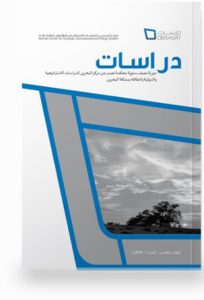
Derasat Journal 2018 – Issue 1
- The Derasat Journal aims to publish rigorous studies on issues related to the Arabian Gulf region, neighboring countries, the Middle East, and the world, particularly with regard to security and defense, economics and energy, from a comprehensive strategic perspective.
- To establish an intellectual dialogue among researchers from the Arabian Gulf region and beyond concerning current challenges and ways to address them.
- To enrich knowledge regarding the Arabian Gulf region and issues of regional and global security.
- Submitted studies must demonstrate originality and provide the journal with “added value,” away from repeating traditional topics, particularly in light of the rapid developments taking place in the region and the world.
- Studies submitted for publication should be relevant to issues concerning the Kingdom of Bahrain and the Gulf states, in addition to regional and international issues that have implications for the Gulf region.
- Submitted studies must maintain objectivity and avoid offending individuals, states, religions, or cultures.
- Studies submitted for publication must not have been previously published elsewhere, whether in print or electronically. The journal retains all intellectual property rights. Therefore, the contributor’s receipt of these conditions along with the assignment email implicitly signifies acceptance of them, and accordingly, the author may not republish material published in the journal elsewhere by any print or electronic means.
- Studies submitted for publication must adhere to recognized academic standards, whether regarding scientific methodology or citation and referencing. The journal follows the Chicago style for references and accepts submissions in both Arabic and English.
- The length of studies submitted for publication should range between 6,000–7,000 words, while book reviews and strategic report reviews should range between 1,500–2,000 words.
The themes of each issue of the journal are announced on the journal’s website at the Bahrain Center for Strategic, International and Energy Studies (DERASAT), inviting submissions related to those themes. Proposals for study ideas are received and discussed by the journal’s Editorial Board, after which the contributor is informed of the Board’s decision. In addition, the Editor-in-Chief may commission certain researchers to prepare studies in line with the journal’s work plan.
- No studies are published in the journal unless approved by the Peer-Review Committee (consisting of two reviewers), which has the authority to accept, reject, or request revisions from the author. The Editor-in-Chief informs the author of the reviewers’ final decision.
- Peer review is conducted by submitting the study without reference to the author’s name, accompanied by the peer-review form published on the journal’s website at the Derasat Center. The form includes four academic criteria: relevance and scope, originality and contribution, theoretical and analytical dimensions, and structure and clarity, in addition to any further comments the reviewer may wish to provide.
- A diverse list of reviewers from various specializations is selected in accordance with the objectives of the journal and the nature of the studies published therein.
Editor-in-Chief
- H.E. Dr. Shaikh Abdulla bin Ahmed bin Abdulla Al Khalifa
Chairman of the Board of Trustees Bahrain Center for Strategic, International and Energy Studies (Derasat) Kingdom of Bahrain
Managing Editor
- Dr. Ashraf Mohammed Keshk
Director of the International and Strategic Studies Program Bahrain Center for Strategic, International and Energy Studies (DERASAT) Kingdom of Bahrain
Dr. Ashraf Mohamed Keshk is a Senior Strategic Studies Expert specializing in Gulf and regional security, with more than three decades of research and academic experience. He received his PhD in Political Science from Cairo University in 2009, with a dissertation on the development of Gulf regional security since 2003: Study on the Impact of NATO Strategy,, which was awarded Best PhD Thesis. In the same year, he obtained a Diploma in Defense Studies from the NATO Defense College in Rome.
He has worked at the Bahrain Center for Strategic, International and Energy Studies (Derasat) since 2012 and currently serves as Director of the Program of Strategic and International Studies. His expertise focuses on Gulf security, defense policies, maritime security, and crisis management. He also served as an Academic Mentor and Lecturer at the NATO Defense College from 2009 to 2018 and has participated extensively in international academic, training, and conference activities.
Dr. Keshk has published extensively on Gulf and regional security. His major books include The Development of Gulf Regional Security since 2003: Study on the Impact of NATO Strategy,, Western Policies Toward the Security of the Arabian Gulf, NATO and the Gulf Countries (Springer, 2021), Maritime Security of the Arab Gulf States (Springer, 2022), and Security and Defense Policies of the Arabian Gulf Countries (2024). He also co-edited Gulf Cooperation Council Achievements and Challenges in 2025.
Associate Editors
- Omar Al-Ubaydli
Studies and Research Director
Bahrain Center for Strategic, International and Energy Studies (DERASAT), Bahrain
- Dr. Abdullah Al-Abbasi
Director of the Energy and Environment Program
Bahrain Center for Strategic, International and Energy Studies (DERASAT), Bahrain
Members
- Dr. Christian Koch
Executive Manager, Gulf Research Center Foundation Brussels and Director of Research
Gulf Research Center Kingdom of Belgium/ Kingdom of Saudi Arabia
- Dr. Osamah Alsayeghi
Research Scientist
Kuwait Institute for Scientific Research (KISR) Nonresident Scholar, Rice University’s Baker Institute for Public Policy State of Kuwait
- Dr. Moataz Salama
Director, Arabian Gulf Program and Head of the Arab and Regional Studies Unit
Al-Ahram Center for Political and Strategic Studies Arab Republic of Egypt
- Dr. Athraa Sayed Abbas Al-Mosawi
Dean of Graduate Studies & Scientific Research, University of Bahrain
Member of the Board of Trustees, Bahrain Center for Strategic, International and Energy Studies (Derasat) Kingdom of Bahrain
This latest issue of the Derasat Journal (1/2018) celebrates the 10th anniversary of the launch of His Majesty, King Hamad bin Isa Al Khalifa’s initiative, Bahrain’s Economic Vision 2030. It also includes research and analyses that consider Europe and the Arabian Gulf; the security strategies of four major powers, Russia, the USA, Europe and NATO; energy security and economics and finally; reports on artificial intelligence and its impact on the possibility of nuclear war, US defense policy in 2018, Russian policy in the Middle East, the civil war in Syria, and the organization of the Gulf Gate Forum in Bahrain promising investment opportunities.
European Security and Defense Transformations and Their Implications for the Arab Region and Its Geographical Surroundings
European-Gulf Relations in the Wake of the British Withdrawal from the European Union
This study seeks to analyze European-Gulf relations in the context of Britain’s decision to withdraw from the European Union in 2016 following the referendum conducted for this purpose. The study is composed of four main parts.
The first: provides a historical background to British-European relations with the Gulf Arab states.
The second: examines the factors that represented obstacles to the development of Gulf-European relations in general.
The third: addresses the future of Gulf-British relations following Britain’s withdrawal from the European Union.
The fourth: discusses the future of Gulf-European relations.
The study concludes with three main findings. The first is that European states will continue to develop their relations with the Gulf states on an individual basis; however, at the same time, the important economic reforms currently being undertaken by the Gulf states, particularly the diversification of sources of income, may provide an incentive for the European Union as a bloc to strengthen its relations with the Gulf states, given that promoting sustainable development lies at the core of the European Union’s interests.
The second finding is that British-Gulf relations may become stronger in the future, particularly at the economic and security levels, which may encourage other European states to follow Britain’s approach.
The third finding is that the trilateral relationship between the European Union, the United Kingdom, and the Gulf Cooperation Council may evolve into one of integration rather than competition, with the political will of the parties determining whether integration or competition prevails.
The first: provides a historical background to British-European relations with the Gulf Arab states.
The second: examines the factors that represented obstacles to the development of Gulf-European relations in general.
The third: addresses the future of Gulf-British relations following Britain’s withdrawal from the European Union.
The fourth: discusses the future of Gulf-European relations.
The study concludes with three main findings. The first is that European states will continue to develop their relations with the Gulf states on an individual basis; however, at the same time, the important economic reforms currently being undertaken by the Gulf states, particularly the diversification of sources of income, may provide an incentive for the European Union as a bloc to strengthen its relations with the Gulf states, given that promoting sustainable development lies at the core of the European Union’s interests.
The second finding is that British-Gulf relations may become stronger in the future, particularly at the economic and security levels, which may encourage other European states to follow Britain’s approach.
The third finding is that the trilateral relationship between the European Union, the United Kingdom, and the Gulf Cooperation Council may evolve into one of integration rather than competition, with the political will of the parties determining whether integration or competition prevails.
Reconsidering Government Economic Subsidies in the Arab World: The Energy Sector as a Model
Many governments in some countries around the world have long provided governmental subsidies for certain goods and services offered to their citizens, especially basic necessities such as food, fuel, and housing. However, this pattern of policies depends primarily on the financial capability of the state. In cases where there are financial surpluses, this grants the state the ability to provide subsidies in all their forms. Yet, in light of the economic crises faced by states, the first mechanism to which they resort is reconsidering subsidies, not toward complete elimination, but rather regulating them so that they reach those who deserve them. Arab states have not been distant from such policies; indeed, there are examples of states that continued to sell basic commodities at enormous costs that represented a burden on their general budgets, which prompted them to reconsider these policies within an integrated system of economic reform. Based on the above, this report addresses the issue of reconsidering governmental subsidies in the Arab world by presenting a brief background on the concept of governmental subsidies, then discussing the effects of subsidy policies on the budgets of Arab states, leading to a discussion of energy price adjustments and the redirection of subsidies.
The report reached the following conclusions:
1. There is a need to establish an integrated strategy, such that any policy for adjusting energy prices should be comprehensive in terms of considering the degree of change, the time period for change, and compensatory measures for vulnerable groups.
2. The need to communicate effectively with public opinion in order to consolidate the principle of societal participation through involving various segments of society in understanding the costs and benefits of subsidies and the plans necessary to reform any imbalance in the subsidy system.
3. The importance of adopting the principle of transparency when lifting subsidies and avoiding resorting to random changes. The report recommends adopting the principle of gradualism in this matter and avoiding large and sudden changes.
The report reached the following conclusions:
1. There is a need to establish an integrated strategy, such that any policy for adjusting energy prices should be comprehensive in terms of considering the degree of change, the time period for change, and compensatory measures for vulnerable groups.
2. The need to communicate effectively with public opinion in order to consolidate the principle of societal participation through involving various segments of society in understanding the costs and benefits of subsidies and the plans necessary to reform any imbalance in the subsidy system.
3. The importance of adopting the principle of transparency when lifting subsidies and avoiding resorting to random changes. The report recommends adopting the principle of gradualism in this matter and avoiding large and sudden changes.
The Bab el-Mandeb Strait and the Challenges of Energy Security
The principal idea of this report revolves around analyzing the present and future threats that may obstruct navigation in the Bab el-Mandeb Strait, especially from the Houthi militias in Yemen. Although this strait possesses great strategic importance as it is considered one of the six vital maritime passages in the world, disrupting navigation in this strait would directly mean the suspension of activity in other passages, including the Suez Canal. At the same time, the importance of the strait lies in keeping both the Strait of Hormuz and the Suez Canal open to navigation without any obstacles, meaning that the relationship among the three passages is governed by interdependence. At a time when global maritime trade is increasing, this coincides with a noticeable rise in maritime terrorism, in addition to other risks, foremost among them maritime piracy, whose rates have increased during recent years. Apart from these threats, the Bab el-Mandeb Strait represents a strategic point of contact between Gulf security and the Horn of Africa, which has made this region an arena for regional-regional and regional-international conflict and competition, raising many questions not only about the reality of the conflict in that region, but also about its future trajectories.
The paper reached the following three conclusions:
1. The most likely scenario is that the Houthi militias will not undertake such a step, as they fully realize that this would effectively mean their definitive end. Everything being circulated falls within the framework of psychological warfare and rumor warfare, which so far appears to have had no effect.
2. In view of the strategic importance of the Bab el-Mandeb Strait, its geographical surroundings, especially in the Horn of Africa states, have transformed into an arena of regional-international conflict reflected in the numerous military bases spread throughout the region, which implies the possibility of confrontation rather than cooperation among the states that established these bases whenever their interests conflict.
3. Based on the importance that this region represents for global energy security, it is important, after the end of the war in Yemen and the control of the legitimate forces—especially in light of the recent achievements attained—to establish developmental and investment projects in the region in a manner that serves the interests of Yemen, in addition to achieving regional stability in general.
The paper reached the following three conclusions:
1. The most likely scenario is that the Houthi militias will not undertake such a step, as they fully realize that this would effectively mean their definitive end. Everything being circulated falls within the framework of psychological warfare and rumor warfare, which so far appears to have had no effect.
2. In view of the strategic importance of the Bab el-Mandeb Strait, its geographical surroundings, especially in the Horn of Africa states, have transformed into an arena of regional-international conflict reflected in the numerous military bases spread throughout the region, which implies the possibility of confrontation rather than cooperation among the states that established these bases whenever their interests conflict.
3. Based on the importance that this region represents for global energy security, it is important, after the end of the war in Yemen and the control of the legitimate forces—especially in light of the recent achievements attained—to establish developmental and investment projects in the region in a manner that serves the interests of Yemen, in addition to achieving regional stability in general.
The Middle East in the American National Security Strategy
This paper seeks to analyze the American National Security Strategy announced by U.S. President Donald Trump on December 18, 2017, which included several key issues. Among them was the view that the contemporary world is competitive in nature, particularly due to both Russia and China, in addition to the principle of “America First,” whereby President Trump criticized previous American ruling elites that sought to build nations abroad while neglecting the domestic sphere. The strategy also emphasized the importance of burden-sharing with allies, especially within the North Atlantic Treaty Organization, based on the perception that the alliance would become stronger when its members assume greater responsibility.
The strategy identified several issues with which it intended to deal, including combating terrorism and confronting Iran, the Arab-Israeli conflict and the peace process, the Syrian crisis, and finally strengthening partnerships and burden-sharing. The strategy also defined three principal objectives for the United States in the Middle East: that the Middle East should not become a safe haven or fertile ground for jihadist terrorists; that no hostile power should dominate the region; and that the region should contribute to the stability of the global energy market.
The paper reached three principal conclusions:
1. The National Security Strategy of the American president identifies major priorities, foremost among them protecting domestic security, increasing economic growth, and supporting the military capabilities of the United States. The strategy emphasized that there is a connection between these three priorities.
2. Despite the importance accorded to the Middle East within the American National Security Strategy through the identification of challenges that the U.S. administration must address, the Middle East is nevertheless viewed—according to the strategy—as a financial burden on the United States. American interest in combating terrorism has also declined due to the relative success achieved in securing the American homeland.
3. Limiting Iran’s regional influence occupies a priority position in President Donald Trump’s strategy toward the Middle East, particularly preventing Iran from reaching the Mediterranean Sea through Syrian territory. In this regard, the United States called upon allies and companies to contribute to the implementation of this strategy.
The strategy identified several issues with which it intended to deal, including combating terrorism and confronting Iran, the Arab-Israeli conflict and the peace process, the Syrian crisis, and finally strengthening partnerships and burden-sharing. The strategy also defined three principal objectives for the United States in the Middle East: that the Middle East should not become a safe haven or fertile ground for jihadist terrorists; that no hostile power should dominate the region; and that the region should contribute to the stability of the global energy market.
The paper reached three principal conclusions:
1. The National Security Strategy of the American president identifies major priorities, foremost among them protecting domestic security, increasing economic growth, and supporting the military capabilities of the United States. The strategy emphasized that there is a connection between these three priorities.
2. Despite the importance accorded to the Middle East within the American National Security Strategy through the identification of challenges that the U.S. administration must address, the Middle East is nevertheless viewed—according to the strategy—as a financial burden on the United States. American interest in combating terrorism has also declined due to the relative success achieved in securing the American homeland.
3. Limiting Iran’s regional influence occupies a priority position in President Donald Trump’s strategy toward the Middle East, particularly preventing Iran from reaching the Mediterranean Sea through Syrian territory. In this regard, the United States called upon allies and companies to contribute to the implementation of this strategy.
The Russian National Security Strategy: An Analytical Reading
This paper seeks to analyze the concept and challenges of Russian national security in accordance with the provisions of the Russian Military Doctrine issued in 2014, followed by the Maritime Military Doctrine issued in 2015. The two doctrines complement one another in clarifying the concept of Russian national security, its challenges, and the mechanisms for confronting them during the coming years. The paper also seeks to shed light on the challenges facing the implementation of this strategy, namely the Russian-American disagreement over a number of issues, including the American anti-missile shield deployed in Eastern European states, the eastward expansion of the North Atlantic Treaty Organization, the Ukrainian crisis, the Syrian file, and the Iranian nuclear file. Finally, the paper highlights the position of the Middle East and the Arabian Gulf within this strategy.
The paper reached three conclusions:
1. Although there is a timing and time frame for national security documents issued by states in general, this does not mean rigidity or the absence of development if the state faces challenges requiring modification of the contents or the timing of issuance. The Russian national security strategies present a clear example of this, as Russian decision-makers viewed that there were threats facing Russia, whether from the United States or from the North Atlantic Treaty Organization, requiring the amendment of these strategies.
2. The Russian National Security Strategy of 2015 adopted a comprehensive concept of national security that goes beyond security in its narrow military sense to a broader perspective that keeps pace with the growth of non-traditional threats and increasing economic and social challenges placing pressure on political stability and societal peace.
3. The Russian National Security Strategy of 2015 linked Russian national security with the Middle East and the Arabian Gulf through three dimensions: the security, strategic, and economic dimensions.
The paper reached three conclusions:
1. Although there is a timing and time frame for national security documents issued by states in general, this does not mean rigidity or the absence of development if the state faces challenges requiring modification of the contents or the timing of issuance. The Russian national security strategies present a clear example of this, as Russian decision-makers viewed that there were threats facing Russia, whether from the United States or from the North Atlantic Treaty Organization, requiring the amendment of these strategies.
2. The Russian National Security Strategy of 2015 adopted a comprehensive concept of national security that goes beyond security in its narrow military sense to a broader perspective that keeps pace with the growth of non-traditional threats and increasing economic and social challenges placing pressure on political stability and societal peace.
3. The Russian National Security Strategy of 2015 linked Russian national security with the Middle East and the Arabian Gulf through three dimensions: the security, strategic, and economic dimensions.
The Strategic Concept of the North Atlantic Treaty Organization “NATO”: Counterterrorism as a Model
This paper seeks to analyze the development of the strategy of the North Atlantic Treaty Organization toward the Middle East in general through focusing on the alliance’s role in combating terrorism, whether based on what was included in the alliance’s strategic concept or through the alliance’s work with partners within its various initiatives in this regard, leading to the possibility of deriving some lessons from which the Arabian Gulf states may benefit. It is observed that the issue of combating terrorism received significant attention within the alliance, as it constituted one of the most prominent challenges facing NATO, especially after the events of September 11, 2001.
The paper reached three conclusions:
1. The issue of combating terrorism was strongly present on the agenda of the alliance, reflecting a new image of NATO not merely as a defensive organization, but as an organization that provides security through various fields, most importantly training and consultations.
2. The Arabian Gulf states can benefit from NATO’s experience in combating terrorism through strengthening intelligence cooperation and considering the establishment of a unified Gulf electronic army to confront the danger of cyberterrorism, in addition to the necessity of developing joint Gulf efforts to confront maritime terrorism.
3. Studying the experiences of other states that sought the assistance of the alliance in order to develop their security capabilities to determine the added value that NATO provided to those states and the extent to which the Arabian Gulf states can benefit from it.
The paper reached three conclusions:
1. The issue of combating terrorism was strongly present on the agenda of the alliance, reflecting a new image of NATO not merely as a defensive organization, but as an organization that provides security through various fields, most importantly training and consultations.
2. The Arabian Gulf states can benefit from NATO’s experience in combating terrorism through strengthening intelligence cooperation and considering the establishment of a unified Gulf electronic army to confront the danger of cyberterrorism, in addition to the necessity of developing joint Gulf efforts to confront maritime terrorism.
3. Studying the experiences of other states that sought the assistance of the alliance in order to develop their security capabilities to determine the added value that NATO provided to those states and the extent to which the Arabian Gulf states can benefit from it.

