

This paper sought to analyze the American strategy toward the Gulf neighboring states, namely Iraq, Yemen, and Syria, which are considered weak states according to international standards. The paper demonstrated that the neorealist school, or structural realism, contributes to understanding the American strategy in the region, and that the nature of the international system and the transformations witnessed globally constitute the primary factor in explaining American strategy in the region. This strategy revolves around building a regional order in which Iran dominates the region, similar to the situation before the Iranian Revolution.
The paper showed that the American strategy under the administration of President Obama was based on leadership from behind, strategic patience, reducing reliance on direct American military intervention in the region, and focusing on local efforts undertaken by regional states in combating terrorism, which occupied the highest priority in Obama’s 2015 strategy.
The paper further explained that the effects of the American strategy pushed Arab states to act unilaterally, despite American reassurance policies, in ways that did not align with American expectations in the region. Nevertheless, the United States realizes that, despite these unilateral actions, the active states in the region still require the American role. The paper therefore does not expect any fundamental changes in American strategy.
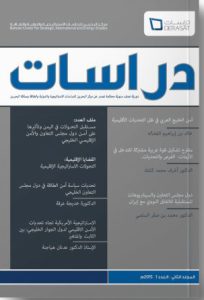
Derasat Journal 2015 – Issue 1
- The Derasat Journal aims to publish rigorous studies on issues related to the Arabian Gulf region, neighboring countries, the Middle East, and the world, particularly with regard to security and defense, economics and energy, from a comprehensive strategic perspective.
- To establish an intellectual dialogue among researchers from the Arabian Gulf region and beyond concerning current challenges and ways to address them.
- To enrich knowledge regarding the Arabian Gulf region and issues of regional and global security.
- Submitted studies must demonstrate originality and provide the journal with “added value,” away from repeating traditional topics, particularly in light of the rapid developments taking place in the region and the world.
- Studies submitted for publication should be relevant to issues concerning the Kingdom of Bahrain and the Gulf states, in addition to regional and international issues that have implications for the Gulf region.
- Submitted studies must maintain objectivity and avoid offending individuals, states, religions, or cultures.
- Studies submitted for publication must not have been previously published elsewhere, whether in print or electronically. The journal retains all intellectual property rights. Therefore, the contributor’s receipt of these conditions along with the assignment email implicitly signifies acceptance of them, and accordingly, the author may not republish material published in the journal elsewhere by any print or electronic means.
- Studies submitted for publication must adhere to recognized academic standards, whether regarding scientific methodology or citation and referencing. The journal follows the Chicago style for references and accepts submissions in both Arabic and English.
- The length of studies submitted for publication should range between 6,000–7,000 words, while book reviews and strategic report reviews should range between 1,500–2,000 words.
The themes of each issue of the journal are announced on the journal’s website at the Bahrain Center for Strategic, International and Energy Studies (DERASAT), inviting submissions related to those themes. Proposals for study ideas are received and discussed by the journal’s Editorial Board, after which the contributor is informed of the Board’s decision. In addition, the Editor-in-Chief may commission certain researchers to prepare studies in line with the journal’s work plan.
- No studies are published in the journal unless approved by the Peer-Review Committee (consisting of two reviewers), which has the authority to accept, reject, or request revisions from the author. The Editor-in-Chief informs the author of the reviewers’ final decision.
- Peer review is conducted by submitting the study without reference to the author’s name, accompanied by the peer-review form published on the journal’s website at the Derasat Center. The form includes four academic criteria: relevance and scope, originality and contribution, theoretical and analytical dimensions, and structure and clarity, in addition to any further comments the reviewer may wish to provide.
- A diverse list of reviewers from various specializations is selected in accordance with the objectives of the journal and the nature of the studies published therein.
Editor-in-Chief
- H.E. Dr. Shaikh Abdulla bin Ahmed bin Abdulla Al Khalifa
Chairman of the Board of Trustees Bahrain Center for Strategic, International and Energy Studies (Derasat) Kingdom of Bahrain
Managing Editor
- Dr. Ashraf Mohammed Keshk
Director of the International and Strategic Studies Program Bahrain Center for Strategic, International and Energy Studies (DERASAT) Kingdom of Bahrain
Dr. Ashraf Mohamed Keshk is a Senior Strategic Studies Expert specializing in Gulf and regional security, with more than three decades of research and academic experience. He received his PhD in Political Science from Cairo University in 2009, with a dissertation on the development of Gulf regional security since 2003: Study on the Impact of NATO Strategy,, which was awarded Best PhD Thesis. In the same year, he obtained a Diploma in Defense Studies from the NATO Defense College in Rome.
He has worked at the Bahrain Center for Strategic, International and Energy Studies (Derasat) since 2012 and currently serves as Director of the Program of Strategic and International Studies. His expertise focuses on Gulf security, defense policies, maritime security, and crisis management. He also served as an Academic Mentor and Lecturer at the NATO Defense College from 2009 to 2018 and has participated extensively in international academic, training, and conference activities.
Dr. Keshk has published extensively on Gulf and regional security. His major books include The Development of Gulf Regional Security since 2003: Study on the Impact of NATO Strategy,, Western Policies Toward the Security of the Arabian Gulf, NATO and the Gulf Countries (Springer, 2021), Maritime Security of the Arab Gulf States (Springer, 2022), and Security and Defense Policies of the Arabian Gulf Countries (2024). He also co-edited Gulf Cooperation Council Achievements and Challenges in 2025.
Associate Editors
- Omar Al-Ubaydli
Studies and Research Director
Bahrain Center for Strategic, International and Energy Studies (DERASAT), Bahrain
- Dr. Abdullah Al-Abbasi
Director of the Energy and Environment Program
Bahrain Center for Strategic, International and Energy Studies (DERASAT), Bahrain
Members
- Dr. Christian Koch
Executive Manager, Gulf Research Center Foundation Brussels and Director of Research
Gulf Research Center Kingdom of Belgium/ Kingdom of Saudi Arabia
- Dr. Osamah Alsayeghi
Research Scientist
Kuwait Institute for Scientific Research (KISR) Nonresident Scholar, Rice University’s Baker Institute for Public Policy State of Kuwait
- Dr. Moataz Salama
Director, Arabian Gulf Program and Head of the Arab and Regional Studies Unit
Al-Ahram Center for Political and Strategic Studies Arab Republic of Egypt
- Dr. Athraa Sayed Abbas Al-Mosawi
Dean of Graduate Studies & Scientific Research, University of Bahrain
Member of the Board of Trustees, Bahrain Center for Strategic, International and Energy Studies (Derasat) Kingdom of Bahrain
A semi-annual specialized journal issued by the Bahrain Center for Strategic, International and Energy Studies in the Kingdom of Bahrain. The journal aims to public studies and reports on political, international, economic, security, energy, and cyberspace issues that relate to strategic issues in the broad sense of the term, and that focus on Arabian Gulf issues in Arabic and English.
American Strategy Toward the Regional Security Challenges of the Gulf Neighboring States: Between Constants and Variables
Black Holes in the Yemeni Economy and Its Challenges in 2015
Yemen is one of the poorest and least developed countries in the Arab world and witnessed severe economic deterioration following the 2011 crisis. The country faces major challenges, including political instability, security and military imbalances, terrorism, the spread of armed militias, low living standards, unemployment, and increasing poverty. These conditions have negatively affected Yemeni society and expanded the informal economy.
The study highlights Yemen’s difficulty in achieving the Millennium Development Goals due to widespread poverty, rapid population growth, weak state institutions, poor infrastructure, water scarcity, and dependence on a rentier economy. According to United Nations reports, Yemen also faces serious humanitarian challenges, including food insecurity, malnutrition, inadequate sanitation, displacement, and lack of basic services. By 2015, more than half of the Yemeni population was living in poverty, while unemployment rates among youth reached alarming levels.
The study argues that long-standing structural imbalances in the Yemeni economy, including weak development planning, limited economic diversification, corruption, and poor governance, contributed significantly to recurring instability and conflict in Yemen.
The study highlights Yemen’s difficulty in achieving the Millennium Development Goals due to widespread poverty, rapid population growth, weak state institutions, poor infrastructure, water scarcity, and dependence on a rentier economy. According to United Nations reports, Yemen also faces serious humanitarian challenges, including food insecurity, malnutrition, inadequate sanitation, displacement, and lack of basic services. By 2015, more than half of the Yemeni population was living in poverty, while unemployment rates among youth reached alarming levels.
The study argues that long-standing structural imbalances in the Yemeni economy, including weak development planning, limited economic diversification, corruption, and poor governance, contributed significantly to recurring instability and conflict in Yemen.
Challenges to Energy Security Policy in the Gulf Cooperation Council States
Over the past decades, the Gulf Cooperation Council (GCC) states have played a pivotal role in maintaining the stability of the global energy market. This role has stemmed partly from the vast oil and natural gas reserves possessed by the Gulf states, but it has also been linked to the nature of the region’s energy policy, led by the Kingdom of Saudi Arabia, which aims to achieve stability in the global energy market through the development of mechanisms that have enabled these states to play a positive role in confronting the numerous crises experienced by the global energy market since the 1970s.
This broad strategic objective is connected to several subsidiary goals, most notably ensuring the competitiveness of oil in the global energy market and maintaining good relations with major oil-importing countries through presence in important markets. This role is not only important for the Gulf states themselves, but is even more significant for major importing countries, especially the United States of America, in a way that has made Gulf energy security policy a central pillar of global energy policy.
During past decades, the Gulf states faced several internal and external challenges in their pursuit of achieving energy security objectives. However, recent regional and international transformations have created both old challenges in new forms and entirely new challenges. As a result, the GCC states can no longer rely on the same mechanisms to address these issues. Current challenges affect all dimensions of Gulf energy security policy, particularly shifts in the global energy production map and their impact on the competitiveness of Gulf oil and gas. Additional concerns include instability in states controlling vital oil transit straits and the difficulties faced by major traditional energy-producing countries. Together, these factors create uncertainty regarding the ability of the Gulf states to adopt clear energy policies, even in the short term.
This broad strategic objective is connected to several subsidiary goals, most notably ensuring the competitiveness of oil in the global energy market and maintaining good relations with major oil-importing countries through presence in important markets. This role is not only important for the Gulf states themselves, but is even more significant for major importing countries, especially the United States of America, in a way that has made Gulf energy security policy a central pillar of global energy policy.
During past decades, the Gulf states faced several internal and external challenges in their pursuit of achieving energy security objectives. However, recent regional and international transformations have created both old challenges in new forms and entirely new challenges. As a result, the GCC states can no longer rely on the same mechanisms to address these issues. Current challenges affect all dimensions of Gulf energy security policy, particularly shifts in the global energy production map and their impact on the competitiveness of Gulf oil and gas. Additional concerns include instability in states controlling vital oil transit straits and the difficulties faced by major traditional energy-producing countries. Together, these factors create uncertainty regarding the ability of the Gulf states to adopt clear energy policies, even in the short term.
Iran and the Houthis: Producing Chaos in Yemen
The rapid emergence of the Houthis in the Yemeni political scene after 2011 generated considerable attention, whether at the regional or international level. The political presence of the Houthis and their control over the institutions of the Yemeni state since September 21, 2014, became linked to their relationship with the Islamic Republic of Iran. Although Iran attempted to deny the extent of its connection with the Houthis, the visit carried out by a delegation of Houthis and their supporters to Iran after the fall of Sana’a under Houthi control—with military assistance from former Yemeni President Ali Abdullah Saleh—ended all doubt surrounding that relationship. That visit, along with the developments that preceded it and the consequences that followed, raised unprecedented concern in the Arab region, particularly among the Gulf Cooperation Council states, foremost among them the Kingdom of Saudi Arabia.
In this context, this study seeks to provide an analysis of the substance of the relationship between the Houthis and Iran, the contexts in which it developed, as well as the scenarios that the Houthis—and with them Iran—seek to achieve within the context of the Yemeni political scene and the Gulf regional environment. The study presents a perspective on what the states of the region can offer with regard to Yemen in order to avoid the negative effects of the chaos that has been manufactured in Yemen through the influence of the relationship between Iran and the Houthis.
In this context, this study seeks to provide an analysis of the substance of the relationship between the Houthis and Iran, the contexts in which it developed, as well as the scenarios that the Houthis—and with them Iran—seek to achieve within the context of the Yemeni political scene and the Gulf regional environment. The study presents a perspective on what the states of the region can offer with regard to Yemen in order to avoid the negative effects of the chaos that has been manufactured in Yemen through the influence of the relationship between Iran and the Houthis.
Proposed Formation of a Joint Arab Force for Intervention in Crises: Opportunities and Challenges
Despite the continuation of regional threats to Arab states, internal threats have become more dangerous, especially following the emergence of non-state groups that possess weapons that may equal or exceed those of the state, with support from regional parties. On the other hand, all indicators point to more instability in many states since 2011 until now. On a third level, it is observed that despite the continuation of the core interests of major powers in the Middle East and the Arabian Gulf, there is a change in the policies of those states, whether in terms of having other interests alongside the Middle East, including Asia, or in terms of not intervening in all crises automatically, but rather studying the extent to which those crises threaten the strategic interests of Western states or not, in addition to indications of rapprochement between Iran and Western states. These transformations have resulted in one outcome: at a time when threats to national and regional security of Arab states are increasing, the mechanisms of Arab action are still limited, which means that there was an urgent necessity to bridge the gap between these threats and the mechanisms required to confront them. This was represented in an idea proposed by Abdel Fattah el-Sisi in his speech to the Egyptian people in February 2015, to form a joint Arab force to confront the security threats facing the region. This proposal was adopted by the Arab Summit held in Sharm El-Sheikh in March 2015. What is the nature of this proposed force, its expected tasks, the legal foundations for its formation, and the obstacles to its work? Answering these questions and others will be the focus of this study.
The Gulf Cooperation Council States and Future Scenarios of the Nuclear Agreement with Iran
After a marathon week in the Swiss city of Lausanne, the P5+1 group (United States of America, France, Russia, China, the United Kingdom, and Germany) announced the success of negotiations and agreement on a general framework to resolve the issue of Iran’s nuclear file, with the drafting of the agreement and its signing scheduled to be completed by the end of June 2015.
This study is not intended to evaluate this agreement or analyze its announced chapters and provisions, nor to address the discrepancies between the statements issued by the White House and the Iranian Ministry of Foreign Affairs, or how this agreement will be implemented, the obstacles it will face, and the like; as all of this requires a separate, detailed study.
The following pages focus on four main axes:
1. Future scenarios for the post-framework agreement phase in resolving the Iranian nuclear crisis.
2. The Iranian position in the event of failure to sign the comprehensive agreement.
3. The future of relations between Iran and the United States of America.
4. The position of the Gulf Cooperation Council states regarding the nuclear agreement between Iran and the P5+1 group.
This study is not intended to evaluate this agreement or analyze its announced chapters and provisions, nor to address the discrepancies between the statements issued by the White House and the Iranian Ministry of Foreign Affairs, or how this agreement will be implemented, the obstacles it will face, and the like; as all of this requires a separate, detailed study.
The following pages focus on four main axes:
1. Future scenarios for the post-framework agreement phase in resolving the Iranian nuclear crisis.
2. The Iranian position in the event of failure to sign the comprehensive agreement.
3. The future of relations between Iran and the United States of America.
4. The position of the Gulf Cooperation Council states regarding the nuclear agreement between Iran and the P5+1 group.
The International Role Toward Yemen
The conflict witnessed in Yemen since 2011 represented a source of threat to international interests in the region, particularly with regard to the safety of international navigation in the Arabian Sea, the Red Sea, and the Bab al-Mandab Strait. This prompted the international community to play an active role in managing this conflict and attempting to settle it. This report sought to analyze the international role toward Yemen through analyzing the roles of the United States of America, the United Nations, and the European Union, as they are regarded among the most prominent international actors in Yemen, with the aim of identifying the motives behind that role and its implications, the extent of consistency in the behavior of its parties, and assessing the size and nature of the influence of international actors on the Yemeni situation.
The report reached the following conclusions:
1. Considerations related to ensuring the safety of international navigation in the Arabian Sea, the Red Sea, and the Bab al-Mandab Strait, as well as combating al-Qaeda, represented the most important motives behind the international role toward Yemen.
2. The international role constituted a fundamental factor in managing the political conflict in Yemen and influencing the course and directions of Yemeni political developments.
3. There existed a degree of consensus in the international position toward the conflict in Yemen. Nevertheless, the interest of each international actor required a certain degree of difference in the behavior of international actors toward developments in the Yemeni situation, particularly at the level of the means and tools of influence over those conditions.
4. Although the international role contributed to preserving the Yemeni state from collapse and to achieving numerous steps toward settlement, it failed to resolve the conflict, whose scope and range expanded. This was due to the imbalance in the equation of power within the Yemeni reality, the conflict of regional and international geopolitical projects in Yemen, and the differing methodologies of international actors in managing the conflict, which ultimately led to the military intervention of the Arab Coalition forces, led by the Kingdom of Saudi Arabia, in order to resolve the conflict.
The report reached the following conclusions:
1. Considerations related to ensuring the safety of international navigation in the Arabian Sea, the Red Sea, and the Bab al-Mandab Strait, as well as combating al-Qaeda, represented the most important motives behind the international role toward Yemen.
2. The international role constituted a fundamental factor in managing the political conflict in Yemen and influencing the course and directions of Yemeni political developments.
3. There existed a degree of consensus in the international position toward the conflict in Yemen. Nevertheless, the interest of each international actor required a certain degree of difference in the behavior of international actors toward developments in the Yemeni situation, particularly at the level of the means and tools of influence over those conditions.
4. Although the international role contributed to preserving the Yemeni state from collapse and to achieving numerous steps toward settlement, it failed to resolve the conflict, whose scope and range expanded. This was due to the imbalance in the equation of power within the Yemeni reality, the conflict of regional and international geopolitical projects in Yemen, and the differing methodologies of international actors in managing the conflict, which ultimately led to the military intervention of the Arab Coalition forces, led by the Kingdom of Saudi Arabia, in order to resolve the conflict.
The Path of Overreach in Yemen: The Houthis from an Idea … to a De Facto Authority
The “Houthis,” or the Yemeni “Ansar Allah” group, emerged on the list of regional and international attention, bringing with them the need to trace the course of “overreach” from the broad realm of thinking about their emergence as a local political group with sectarian beliefs and external connections. The phenomenon represented one that seized the opportunity for expansion and extension as a result of the continued “inability” of the Yemeni authorities in the face of the continued “movement” of this phenomenon from Saada to Aden, until it ignited a regional war in the area.
In order to understand the course of Houthi “overreach” from local confrontations to regional war, it was necessary to study and present the origins of the group by revealing the nature of the founding ideas of the movement or group in terms of its geographical “locality” and political “regionality.” These ideas served as fuel for the continuation of the movement through the opposing and supportive views it encompassed toward currents here and there, becoming their ammunition during the armed confrontations with the authorities from 2004–2010, until they seized upon the “labor pains of change in Yemen” in 2011.
This occurred before their participation in the “Comprehensive National Dialogue Conference: March 18, 2013 – January 25, 2014,” through presenting visions and remedies in the “Mövenpick Dialogues,” accompanied by military and political activities that paved the way toward the Peace and National Partnership Agreement, followed by the cascading events before — and during — their sudden transition from the field of combat and opposition to the office of governance and authority after signing the Peace and National Partnership Agreement following their entry into Sana’a on September 21, 2014, until the issuance of the Constitutional Declaration on February 6, 2015, whereby they embodied the “de facto authority,” moving from the “obstacles” of implementing the seventh clause of the Doha Agreement (June 2007) to the “sanctions” of Chapter VII of the United Nations Charter, causing the leaders of the movement and its military arms to become Yemeni names mentioned in presidential statements and United Nations Security Council resolutions related to Yemeni affairs in August 2014 and February–April 2015.
The report addressed the environment and favorable climate for the movement’s ideology, the establishment activities, and the lectures of the founder Hussein al-Houthi, as well as the “alliances for preserving Zaydi identity” with certain parties within the authority and the opposition to confront the “Wahhabi” tide. In addition, it examined the external influences on the movement through discussing the Houthi-Iranian relationship as one of the tools for strengthening the Houthis, alongside the series of armed confrontations, “taqiyya,” and external mediations. The report also noted their defined position regarding the outcomes of the dialogue and their perception of the concept of “national partnership,” thereby cultivating “internal and external rivalries” that would have their impact on the “future of the movement” in Yemen.
In order to understand the course of Houthi “overreach” from local confrontations to regional war, it was necessary to study and present the origins of the group by revealing the nature of the founding ideas of the movement or group in terms of its geographical “locality” and political “regionality.” These ideas served as fuel for the continuation of the movement through the opposing and supportive views it encompassed toward currents here and there, becoming their ammunition during the armed confrontations with the authorities from 2004–2010, until they seized upon the “labor pains of change in Yemen” in 2011.
This occurred before their participation in the “Comprehensive National Dialogue Conference: March 18, 2013 – January 25, 2014,” through presenting visions and remedies in the “Mövenpick Dialogues,” accompanied by military and political activities that paved the way toward the Peace and National Partnership Agreement, followed by the cascading events before — and during — their sudden transition from the field of combat and opposition to the office of governance and authority after signing the Peace and National Partnership Agreement following their entry into Sana’a on September 21, 2014, until the issuance of the Constitutional Declaration on February 6, 2015, whereby they embodied the “de facto authority,” moving from the “obstacles” of implementing the seventh clause of the Doha Agreement (June 2007) to the “sanctions” of Chapter VII of the United Nations Charter, causing the leaders of the movement and its military arms to become Yemeni names mentioned in presidential statements and United Nations Security Council resolutions related to Yemeni affairs in August 2014 and February–April 2015.
The report addressed the environment and favorable climate for the movement’s ideology, the establishment activities, and the lectures of the founder Hussein al-Houthi, as well as the “alliances for preserving Zaydi identity” with certain parties within the authority and the opposition to confront the “Wahhabi” tide. In addition, it examined the external influences on the movement through discussing the Houthi-Iranian relationship as one of the tools for strengthening the Houthis, alongside the series of armed confrontations, “taqiyya,” and external mediations. The report also noted their defined position regarding the outcomes of the dialogue and their perception of the concept of “national partnership,” thereby cultivating “internal and external rivalries” that would have their impact on the “future of the movement” in Yemen.

