

This study aims to analyze the trajectory of Turkish-Gulf relations, which have witnessed significant developments over the past years, marked by high-level exchange visits between both sides. Additionally, several bilateral coordination mechanisms.
The study concluded with three main findings:
First: In a world increasingly moving away from unipolarity, it has become essential for Turkey and the Gulf States to develop strategic relations to face new challenges. By providing the necessary institutional and organizational frameworks, the bilateral partnership between both sides can achieve mutual benefits and ensure regional stability. This has been realized through the establishment of joint committees and coordination councils between Turkey and several Gulf States.
Second: Turkey possesses military capabilities and diplomatic strengths that make it an important partner for the Gulf States. At the same time, these countries have economic capacities and regional influence, meaning that the foundation for integration in capabilities and visions represents a significant starting point for both parties to play an important regional role. This is crucial for maintaining the balance of power amidst the changing strategies of major powers towards the region and the multiple shared risks and threats.
Third: Both Turkey and the Gulf States are located in a turbulent region with numerous challenges that have caused tensions in their relations. However, if priorities are identified and ways to preserve them are established, the prospects for these relations will be fruitful for both parties.
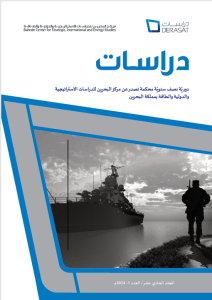
Derasat Journal 2024 – Issue 1
- The Derasat Journal aims to publish rigorous studies on issues related to the Arabian Gulf region, neighboring countries, the Middle East, and the world, particularly with regard to security and defense, economics and energy, from a comprehensive strategic perspective.
- To establish an intellectual dialogue among researchers from the Arabian Gulf region and beyond concerning current challenges and ways to address them.
- To enrich knowledge regarding the Arabian Gulf region and issues of regional and global security.
- Submitted studies must demonstrate originality and provide the journal with “added value,” away from repeating traditional topics, particularly in light of the rapid developments taking place in the region and the world.
- Studies submitted for publication should be relevant to issues concerning the Kingdom of Bahrain and the Gulf states, in addition to regional and international issues that have implications for the Gulf region.
- Submitted studies must maintain objectivity and avoid offending individuals, states, religions, or cultures.
- Studies submitted for publication must not have been previously published elsewhere, whether in print or electronically. The journal retains all intellectual property rights. Therefore, the contributor’s receipt of these conditions along with the assignment email implicitly signifies acceptance of them, and accordingly, the author may not republish material published in the journal elsewhere by any print or electronic means.
- Studies submitted for publication must adhere to recognized academic standards, whether regarding scientific methodology or citation and referencing. The journal follows the Chicago style for references and accepts submissions in both Arabic and English.
- The length of studies submitted for publication should range between 6,000–7,000 words, while book reviews and strategic report reviews should range between 1,500–2,000 words.
The themes of each issue of the journal are announced on the journal’s website at the Bahrain Center for Strategic, International and Energy Studies (DERASAT), inviting submissions related to those themes. Proposals for study ideas are received and discussed by the journal’s Editorial Board, after which the contributor is informed of the Board’s decision. In addition, the Editor-in-Chief may commission certain researchers to prepare studies in line with the journal’s work plan.
- No studies are published in the journal unless approved by the Peer-Review Committee (consisting of two reviewers), which has the authority to accept, reject, or request revisions from the author. The Editor-in-Chief informs the author of the reviewers’ final decision.
- Peer review is conducted by submitting the study without reference to the author’s name, accompanied by the peer-review form published on the journal’s website at the Derasat Center. The form includes four academic criteria: relevance and scope, originality and contribution, theoretical and analytical dimensions, and structure and clarity, in addition to any further comments the reviewer may wish to provide.
- A diverse list of reviewers from various specializations is selected in accordance with the objectives of the journal and the nature of the studies published therein.
Editor-in-Chief
- H.E. Dr. Shaikh Abdulla bin Ahmed bin Abdulla Al Khalifa
Chairman of the Board of Trustees Bahrain Center for Strategic, International and Energy Studies (Derasat) Kingdom of Bahrain
Managing Editor
- Dr. Ashraf Mohammed Keshk
Director of the International and Strategic Studies Program Bahrain Center for Strategic, International and Energy Studies (DERASAT) Kingdom of Bahrain
Dr. Ashraf Mohamed Keshk is a Senior Strategic Studies Expert specializing in Gulf and regional security, with more than three decades of research and academic experience. He received his PhD in Political Science from Cairo University in 2009, with a dissertation on the development of Gulf regional security since 2003: Study on the Impact of NATO Strategy,, which was awarded Best PhD Thesis. In the same year, he obtained a Diploma in Defense Studies from the NATO Defense College in Rome.
He has worked at the Bahrain Center for Strategic, International and Energy Studies (Derasat) since 2012 and currently serves as Director of the Program of Strategic and International Studies. His expertise focuses on Gulf security, defense policies, maritime security, and crisis management. He also served as an Academic Mentor and Lecturer at the NATO Defense College from 2009 to 2018 and has participated extensively in international academic, training, and conference activities.
Dr. Keshk has published extensively on Gulf and regional security. His major books include The Development of Gulf Regional Security since 2003: Study on the Impact of NATO Strategy,, Western Policies Toward the Security of the Arabian Gulf, NATO and the Gulf Countries (Springer, 2021), Maritime Security of the Arab Gulf States (Springer, 2022), and Security and Defense Policies of the Arabian Gulf Countries (2024). He also co-edited Gulf Cooperation Council Achievements and Challenges in 2025.
Associate Editors
- Omar Al-Ubaydli
Studies and Research Director
Bahrain Center for Strategic, International and Energy Studies (DERASAT), Bahrain
- Dr. Abdullah Al-Abbasi
Director of the Energy and Environment Program
Bahrain Center for Strategic, International and Energy Studies (DERASAT), Bahrain
Members
- Dr. Christian Koch
Executive Manager, Gulf Research Center Foundation Brussels and Director of Research
Gulf Research Center Kingdom of Belgium/ Kingdom of Saudi Arabia
- Dr. Osamah Alsayeghi
Research Scientist
Kuwait Institute for Scientific Research (KISR) Nonresident Scholar, Rice University’s Baker Institute for Public Policy State of Kuwait
- Dr. Moataz Salama
Director, Arabian Gulf Program and Head of the Arab and Regional Studies Unit
Al-Ahram Center for Political and Strategic Studies Arab Republic of Egypt
- Dr. Athraa Sayed Abbas Al-Mosawi
Dean of Graduate Studies & Scientific Research, University of Bahrain
Member of the Board of Trustees, Bahrain Center for Strategic, International and Energy Studies (Derasat) Kingdom of Bahrain
This paper presents the main idea that despite the regional security conditions that led to the establishment of the Gulf Cooperation Council (GCC) in 1981, integration among the Gulf countries in all fields, including the economy, has been significant, as highlighted in the preamble and Article 4 of the GCC Charter. This paper aims to analyze this issue based on the concept of comparative advantages of the Gulf countries and their role in achieving this integration, as reflected in the different frameworks of economic integration
New Horizons in Middle East Diplomacy: Turkey and the Gulf States Amidst Regional and Global Transformations
The Arab Vision for the Security of the Red Sea and the Bab al-Mandab Strait
This study aims to analyze the Arab vision for the security of the Red Sea and Bab al-Mandab in light of the threats that have intensified since the start of the Gaza events in October 2023. While these events did not create these threats, they revealed the profound impact of regional crises on maritime security. Furthermore, the study seeks to explore the obstacles to crystallizing a collective vision—or rather, a regional security framework—for the security of this region, given its growing importance to both the Red Sea littoral states and international actors alike.
The study concluded with three main findings:
First: The study highlights the determinants shaping the visions of the countries surrounding the Red Sea, which serve as the foundational pillars of their perspectives. These include the specific risks facing each state, its coastal access to the sea, internal stability, and calculations regarding relations with foreign powers. Together, these factors combine to explain the positions of these countries regarding the security of the Red Sea and the Bab al-Mandab Strait.
Second: Despite the strategic importance of the Red Sea—often described as an "Arab Lake" due to the extensive Arab coastlines along it—and despite the critical importance of the Bab al-Mandab Strait for these countries' trade with the outside world, no comprehensive and effective regional initiative regarding maritime or regional security in the area exists to date. This is due to numerous reasons, including the internal challenges facing the region's countries, heightened international polarization targeting them, and regional rivalry.
Third: The war in Gaza has reaffirmed the close link between regional security and maritime security. Although threats to maritime security have been strongly present throughout the region's history—since marine waterways have existed since ancient times with their recognized geography and legal statuses—the changing variable is the development of regional security and its direct reflections on maritime stability or prosperity.
Conflict parties, whether states or non-state actors, may resort to weaponizing vital waterways in regional conflicts. This triggers international interventions, thereby intensifying international competition near these straits. This reinforces the importance of evolving the Arab vision for the security of navigation in the Red Sea and Bab al-Mandab beyond the traditional perspective, which previously focused solely on keeping the region insulated from international conflicts.
The study concluded with three main findings:
First: The study highlights the determinants shaping the visions of the countries surrounding the Red Sea, which serve as the foundational pillars of their perspectives. These include the specific risks facing each state, its coastal access to the sea, internal stability, and calculations regarding relations with foreign powers. Together, these factors combine to explain the positions of these countries regarding the security of the Red Sea and the Bab al-Mandab Strait.
Second: Despite the strategic importance of the Red Sea—often described as an "Arab Lake" due to the extensive Arab coastlines along it—and despite the critical importance of the Bab al-Mandab Strait for these countries' trade with the outside world, no comprehensive and effective regional initiative regarding maritime or regional security in the area exists to date. This is due to numerous reasons, including the internal challenges facing the region's countries, heightened international polarization targeting them, and regional rivalry.
Third: The war in Gaza has reaffirmed the close link between regional security and maritime security. Although threats to maritime security have been strongly present throughout the region's history—since marine waterways have existed since ancient times with their recognized geography and legal statuses—the changing variable is the development of regional security and its direct reflections on maritime stability or prosperity.
Conflict parties, whether states or non-state actors, may resort to weaponizing vital waterways in regional conflicts. This triggers international interventions, thereby intensifying international competition near these straits. This reinforces the importance of evolving the Arab vision for the security of navigation in the Red Sea and Bab al-Mandab beyond the traditional perspective, which previously focused solely on keeping the region insulated from international conflicts.
The European Role in Maritime Security in the Red Sea and the Arabian Gulf and Opportunities for Cooperation with Regional Parties
This study aims to analyze the European Union's strategy for maintaining maritime security in the Arabian Gulf, the Red Sea, and Bab al-Mandab, as well as to explore opportunities for cooperation between the European Union and regional parties. The paper starts from the hypothesis that although European countries agree with the United States on the necessity of maintaining maritime security in this strategic region of the world, this has not prevented the EU from pursuing relatively independent policies regarding this issue.
The study reached three main conclusions:
First: Strategic documents issued by the European Union reflect the importance of maritime security within the EU's national security plans, particularly in two documents: the concept of coordinated maritime presence in the northwestern Indian Ocean approved by the EU in 2022, and the EU's review of its maritime security strategy and its associated action plan in 2023. These documents encompass various fields, including maritime activities, cooperation with partners, and leadership in maritime security awareness.
Second: Despite European support for the United States in its efforts to maintain maritime security in certain alliances, this has not prevented the EU from maintaining a distinct and independent policy in this field. Examples include the EU mission to monitor maritime navigation in the Strait of Hormuz in 2020 and the EU mission for Red Sea and Bab al-Mandab security in February 2024. These policies align with the broader outlines of EU policy and serve European interests.
Third: The importance of European efforts in maintaining maritime security in the Arabian Gulf and the Red Sea can be leveraged to enhance cooperation with regional parties collectively. This includes EU support for the initiative to establish the Council of the Red Sea and Gulf of Aden countries in 2020. Another framework for cooperation is the partnership strategy launched by the European Union with the Gulf Cooperation Council countries in 2022.
The study reached three main conclusions:
First: Strategic documents issued by the European Union reflect the importance of maritime security within the EU's national security plans, particularly in two documents: the concept of coordinated maritime presence in the northwestern Indian Ocean approved by the EU in 2022, and the EU's review of its maritime security strategy and its associated action plan in 2023. These documents encompass various fields, including maritime activities, cooperation with partners, and leadership in maritime security awareness.
Second: Despite European support for the United States in its efforts to maintain maritime security in certain alliances, this has not prevented the EU from maintaining a distinct and independent policy in this field. Examples include the EU mission to monitor maritime navigation in the Strait of Hormuz in 2020 and the EU mission for Red Sea and Bab al-Mandab security in February 2024. These policies align with the broader outlines of EU policy and serve European interests.
Third: The importance of European efforts in maintaining maritime security in the Arabian Gulf and the Red Sea can be leveraged to enhance cooperation with regional parties collectively. This includes EU support for the initiative to establish the Council of the Red Sea and Gulf of Aden countries in 2020. Another framework for cooperation is the partnership strategy launched by the European Union with the Gulf Cooperation Council countries in 2022.
The Impact of Economic Integration on Inter-Gulf Trade
This paper presents the main idea that despite the regional security conditions that led to the establishment of the Gulf Cooperation Council (GCC) in 1981, integration among the Gulf countries in all fields, including the economy, has been significant, as highlighted in the preamble and Article 4 of the GCC Charter. This paper aims to analyze this issue based on the concept of comparative advantages of the Gulf countries and their role in achieving this integration, as reflected in the different frameworks of economic integration. The paper concludes with three main findings:
First: The Gulf countries have achieved clear accomplishments in trade exchanges based on the comparative advantage model, as reflected in official figures and data. Comparative advantages not only increase the volume of trade exchanges but also significantly contribute to achieving economic integration.
Second: Despite the importance of economic integration rates among the Gulf countries, they are still lower than those of other similar blocs, such as the European Union. This is due to the homogeneity of the Gulf economies on the one hand, and the lack of adherence to inter-trade rules on the other.
Third: The study proposes discussing new mechanisms through which the rules of inter-trade can be implemented, similar to practices in some other regional blocs.
First: The Gulf countries have achieved clear accomplishments in trade exchanges based on the comparative advantage model, as reflected in official figures and data. Comparative advantages not only increase the volume of trade exchanges but also significantly contribute to achieving economic integration.
Second: Despite the importance of economic integration rates among the Gulf countries, they are still lower than those of other similar blocs, such as the European Union. This is due to the homogeneity of the Gulf economies on the one hand, and the lack of adherence to inter-trade rules on the other.
Third: The study proposes discussing new mechanisms through which the rules of inter-trade can be implemented, similar to practices in some other regional blocs.
The Impact of Maritime Navigation Threats in Bab al-Mandeb and the Red Sea on the Security of the Arabi an Gulf States
This study aims to analyze the impact of maritime security threats in Bab al-Mandeb and the Red Sea on the interests and security of the Arabian Gulf States, which primarily rely on maritime routes for their trade with the outside world. The main idea of the study is that these impacts are multifaceted, encompassing economic, geostrategic, and security dimensions. This region is of interest to several regional and international powers simultaneously, necessitating a comprehensive vision of this issue and its short- and long-term effects, especially since maritime security threats are closely linked to regional instability.
The study concludes with three main findings:
First: Despite some global shipping companies deciding to reroute away from Bab al-Mandeb Strait, the increase in shipping fees and piracy risks still underscores the importance of addressing maritime security threats in Bab al-Mandeb, an international waterway for all nations. Therefore, confronting threats in this area is a strategic necessity for countries, highlighting the importance of regional and international agreements on ways to tackle these threats.
Second: The economic and security impacts on the Arabian Gulf States due to maritime security threats are varied. On the security side, issues like illegal migration, maritime terrorism, and the resurgence of piracy have surfaced. Economically, there is an increase in shipping costs, impacts on food supply chains, and the tourism sector, all of which are interconnected and significant to the Gulf States.
Third: Despite the importance of regional and international efforts to address maritime security threats in the Red Sea and Bab al- Mandeb, the region is witnessing intense regional and international competition to establish military bases, leading to its militarization.
The study concludes with three main findings:
First: Despite some global shipping companies deciding to reroute away from Bab al-Mandeb Strait, the increase in shipping fees and piracy risks still underscores the importance of addressing maritime security threats in Bab al-Mandeb, an international waterway for all nations. Therefore, confronting threats in this area is a strategic necessity for countries, highlighting the importance of regional and international agreements on ways to tackle these threats.
Second: The economic and security impacts on the Arabian Gulf States due to maritime security threats are varied. On the security side, issues like illegal migration, maritime terrorism, and the resurgence of piracy have surfaced. Economically, there is an increase in shipping costs, impacts on food supply chains, and the tourism sector, all of which are interconnected and significant to the Gulf States.
Third: Despite the importance of regional and international efforts to address maritime security threats in the Red Sea and Bab al- Mandeb, the region is witnessing intense regional and international competition to establish military bases, leading to its militarization.
The Role of the United States in Maintaining Maritime Navigation in the Arabian Gulf and the Red Sea
This study aims to analyze the efforts led by the United States to maintain maritime navigation and ensure maritime security in the Arabian Gulf, the Red Sea, and Bab al- Mandeb through the establishment of three coalitions. The first coalition is Operation Earnest Will during the Iran-Iraq War in the 1980s. The second is the Maritime Security Construct in the Arabian Gulf in 2019. The third is the Coalition of Prosperity Guardian in 2023.
The study concluded with three main findings:
First: The United States' commitment to leading these coalitions reflects its dedication to the region's security, regardless of speculations about its withdrawal. The U.S. was the only international power capable of leading the coalitions necessary for the security of the Arabian Gulf region and its surroundings, demonstrating its commitment to the security of its allies and partners.
Second: Despite the significant impact of maritime security threats on the interests of both regional and international parties, it has been observed that the contributions of countries alongside the United States varied. During the Iran-Iraq War, there was European hesitation, and not all countries participated in Operation Earnest Will. In 2019, only six countries announced their participation in the Maritime Security Construct in the Arabian Gulf. However, in the Coalition of Prosperity Guardian in 2023, 26 countries declared their participation. This indicates that the establishment of coalitions is not automatic but rather depends on circumstances and the interests of the countries involved.
Third: Although coalitions are essential for facing certain risks or maintaining the balance of power, addressing maritime security threats requires comprehensive and sustainable visions given the importance of waterways for all nations.
The study concluded with three main findings:
First: The United States' commitment to leading these coalitions reflects its dedication to the region's security, regardless of speculations about its withdrawal. The U.S. was the only international power capable of leading the coalitions necessary for the security of the Arabian Gulf region and its surroundings, demonstrating its commitment to the security of its allies and partners.
Second: Despite the significant impact of maritime security threats on the interests of both regional and international parties, it has been observed that the contributions of countries alongside the United States varied. During the Iran-Iraq War, there was European hesitation, and not all countries participated in Operation Earnest Will. In 2019, only six countries announced their participation in the Maritime Security Construct in the Arabian Gulf. However, in the Coalition of Prosperity Guardian in 2023, 26 countries declared their participation. This indicates that the establishment of coalitions is not automatic but rather depends on circumstances and the interests of the countries involved.
Third: Although coalitions are essential for facing certain risks or maintaining the balance of power, addressing maritime security threats requires comprehensive and sustainable visions given the importance of waterways for all nations.

