

This study aims to analyze the experience of the United Arab Emirates (UAE) in employing artificial intelligence in various fields. The UAE secured the first position in the Arab world and the twenty-eighth globally in the 2023 Global Artificial Intelligence Index, released by the international company "Tortoise Media," specializing in artificial intelligence. The index covers 62 countries worldwide, reflecting the efforts of the UAE in this field, both institutionally and legislatively, in addition to allocating the necessary budget for this sector. Furthermore, the study highlights the development of the required human resources and the dissemination of artificial intelligence culture across different segments of society, aligning with modern developments in this regard. The study concludes with three key results:
Legislation plays a crucial role in the success of any strategy, especially those characterized by flexibility to align with the rapid developments in this field. This is evident in the ambitious and integrated strategies, such as the UAE's launch of the Artificial Intelligence Strategy in 2017. The strategy aims to rely on artificial intelligence in services and data analysis by 100% by the year 2031. Additionally, it emphasizes the institutional framework by appointing a minister responsible for the issue, along with a focus on scientific research, education, and training.
The UAE has achieved numerous successes in employing artificial intelligence in various sectors, including security, safety, healthcare, roads, transportation, electricity, education, oil and gas, and artificial intelligence governance.
Several Arab countries can benefit from the UAE's experience in artificial intelligence by understanding the key success factors, including investing in education and scientific research, developing artificial intelligence technologies, and preparing graduates for the jobs provided by artificial intelligence. It also involves defining a realistic artificial intelligence strategy with a commitment to its implementation within specific timelines supported by funding and monitoring.
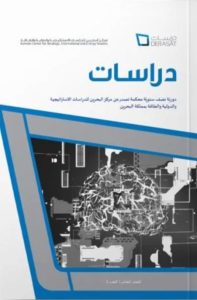
Derasat Journal 2023 – Issue 2
- The Derasat Journal aims to publish rigorous studies on issues related to the Arabian Gulf region, neighboring countries, the Middle East, and the world, particularly with regard to security and defense, economics and energy, from a comprehensive strategic perspective.
- To establish an intellectual dialogue among researchers from the Arabian Gulf region and beyond concerning current challenges and ways to address them.
- To enrich knowledge regarding the Arabian Gulf region and issues of regional and global security.
- Submitted studies must demonstrate originality and provide the journal with “added value,” away from repeating traditional topics, particularly in light of the rapid developments taking place in the region and the world.
- Studies submitted for publication should be relevant to issues concerning the Kingdom of Bahrain and the Gulf states, in addition to regional and international issues that have implications for the Gulf region.
- Submitted studies must maintain objectivity and avoid offending individuals, states, religions, or cultures.
- Studies submitted for publication must not have been previously published elsewhere, whether in print or electronically. The journal retains all intellectual property rights. Therefore, the contributor’s receipt of these conditions along with the assignment email implicitly signifies acceptance of them, and accordingly, the author may not republish material published in the journal elsewhere by any print or electronic means.
- Studies submitted for publication must adhere to recognized academic standards, whether regarding scientific methodology or citation and referencing. The journal follows the Chicago style for references and accepts submissions in both Arabic and English.
- The length of studies submitted for publication should range between 6,000–7,000 words, while book reviews and strategic report reviews should range between 1,500–2,000 words.
The themes of each issue of the journal are announced on the journal’s website at the Bahrain Center for Strategic, International and Energy Studies (DERASAT), inviting submissions related to those themes. Proposals for study ideas are received and discussed by the journal’s Editorial Board, after which the contributor is informed of the Board’s decision. In addition, the Editor-in-Chief may commission certain researchers to prepare studies in line with the journal’s work plan.
- No studies are published in the journal unless approved by the Peer-Review Committee (consisting of two reviewers), which has the authority to accept, reject, or request revisions from the author. The Editor-in-Chief informs the author of the reviewers’ final decision.
- Peer review is conducted by submitting the study without reference to the author’s name, accompanied by the peer-review form published on the journal’s website at the Derasat Center. The form includes four academic criteria: relevance and scope, originality and contribution, theoretical and analytical dimensions, and structure and clarity, in addition to any further comments the reviewer may wish to provide.
- A diverse list of reviewers from various specializations is selected in accordance with the objectives of the journal and the nature of the studies published therein.
Editor-in-Chief
- H.E. Dr. Shaikh Abdulla bin Ahmed bin Abdulla Al Khalifa
Chairman of the Board of Trustees Bahrain Center for Strategic, International and Energy Studies (Derasat) Kingdom of Bahrain
Managing Editor
- Dr. Ashraf Mohammed Keshk
Director of the International and Strategic Studies Program Bahrain Center for Strategic, International and Energy Studies (DERASAT) Kingdom of Bahrain
Dr. Ashraf Mohamed Keshk is a Senior Strategic Studies Expert specializing in Gulf and regional security, with more than three decades of research and academic experience. He received his PhD in Political Science from Cairo University in 2009, with a dissertation on the development of Gulf regional security since 2003: Study on the Impact of NATO Strategy,, which was awarded Best PhD Thesis. In the same year, he obtained a Diploma in Defense Studies from the NATO Defense College in Rome.
He has worked at the Bahrain Center for Strategic, International and Energy Studies (Derasat) since 2012 and currently serves as Director of the Program of Strategic and International Studies. His expertise focuses on Gulf security, defense policies, maritime security, and crisis management. He also served as an Academic Mentor and Lecturer at the NATO Defense College from 2009 to 2018 and has participated extensively in international academic, training, and conference activities.
Dr. Keshk has published extensively on Gulf and regional security. His major books include The Development of Gulf Regional Security since 2003: Study on the Impact of NATO Strategy,, Western Policies Toward the Security of the Arabian Gulf, NATO and the Gulf Countries (Springer, 2021), Maritime Security of the Arab Gulf States (Springer, 2022), and Security and Defense Policies of the Arabian Gulf Countries (2024). He also co-edited Gulf Cooperation Council Achievements and Challenges in 2025.
Associate Editors
- Omar Al-Ubaydli
Studies and Research Director
Bahrain Center for Strategic, International and Energy Studies (DERASAT), Bahrain
- Dr. Abdullah Al-Abbasi
Director of the Energy and Environment Program
Bahrain Center for Strategic, International and Energy Studies (DERASAT), Bahrain
Members
- Dr. Christian Koch
Executive Manager, Gulf Research Center Foundation Brussels and Director of Research
Gulf Research Center Kingdom of Belgium/ Kingdom of Saudi Arabia
- Dr. Osamah Alsayeghi
Research Scientist
Kuwait Institute for Scientific Research (KISR) Nonresident Scholar, Rice University’s Baker Institute for Public Policy State of Kuwait
- Dr. Moataz Salama
Director, Arabian Gulf Program and Head of the Arab and Regional Studies Unit
Al-Ahram Center for Political and Strategic Studies Arab Republic of Egypt
- Dr. Athraa Sayed Abbas Al-Mosawi
Dean of Graduate Studies & Scientific Research, University of Bahrain
Member of the Board of Trustees, Bahrain Center for Strategic, International and Energy Studies (Derasat) Kingdom of Bahrain
The Bahrain Center for Strategic, International and Energy Studies (Derasat) published a new issue of Derasat Journal, its biannual peer-reviewed scientific journal, which examined several political, economic, and security issues from a strategic perspective.
Artificial Intelligence in the United Arab Emirates: A Pioneering Experience in the Arab World
Legal Responsibility for the Use of Artificial Intelligence Systems in the Military
This study aims to analyze the impact of international competition on the use of artificial intelligence (AI) in the military, specifically focusing on the negative implications of responsibility for employing such technologies. The study delves into the details of various AI-equipped weaponry systems, addressing their significant advancements, particularly in reducing human casualties in wars. However, th study raises questions and debates regarding how these systems can achieve their goals while respecting international humanitarian law and ensuring accountability for potential violations.
The study concludes with three key results:
Existing international humanitarian law contains crucial provisions regarding the use of modern technologies within the legal framework during armed conflicts. The objective is to strike a balance between military necessity and humane treatment There are ongoing international efforts and discussions emphasizing the need to maintain a minimum level of human oversight and control when utilizing these systems. This is not only to ensure compliance with international humanitarian law but also due to variations in countries’ perspectives on this matter.
The responsibility lies with the state employing such technology, based on the objective theory that establishes a direct causal relationship between the state’s activity or any of its official apparatuses and the prohibited incident under international law. Therefore, a state committing an armed act through its armed forces is obligated to compensate for all resulting damages.
The negative effects on humans resulting from the use of AI in military systems require continued efforts from the international community, including states and organizations. The goal is to establish a legal framework that addresses the challenges and diverse impacts arising from the development and production of these systems, especially autonomous ones. This framework should promote their responsible and ethical use in accordance with the principles and rules of international humanitarian law.
The study concludes with three key results:
Existing international humanitarian law contains crucial provisions regarding the use of modern technologies within the legal framework during armed conflicts. The objective is to strike a balance between military necessity and humane treatment There are ongoing international efforts and discussions emphasizing the need to maintain a minimum level of human oversight and control when utilizing these systems. This is not only to ensure compliance with international humanitarian law but also due to variations in countries’ perspectives on this matter.
The responsibility lies with the state employing such technology, based on the objective theory that establishes a direct causal relationship between the state’s activity or any of its official apparatuses and the prohibited incident under international law. Therefore, a state committing an armed act through its armed forces is obligated to compensate for all resulting damages.
The negative effects on humans resulting from the use of AI in military systems require continued efforts from the international community, including states and organizations. The goal is to establish a legal framework that addresses the challenges and diverse impacts arising from the development and production of these systems, especially autonomous ones. This framework should promote their responsible and ethical use in accordance with the principles and rules of international humanitarian law.
NATO’s Strategy in Harnessing Artificial Intelligence in Defense
This study aims to analyze the strategies announced by the North Atlantic Treaty Organization (NATO) in harnessing artificial intelligence in the field of defense. Despite being and remaining the strongest defense organization globally, NATO has recognized that the criterion for strength has surpassed traditional military capabilities due to the remarkable technological advancements that have impacted all aspects of life, including the military domain. This has prompted NATO decision-makers to emphasize the importance of the "digital alliance.” The alliance unveiled its first strategy on emerging technologies in January 2024 as part of ongoing efforts to engage allies in this field.
The study has yielded three main findings:
Emphasizing the importance of NATO's commitment to developing mechanisms to address the risks posed by emerging technologies aligns with the alliance’s standards, values, and principles of international law. This ensures that NATO’s efforts do not become a source of intense global competition, impacting global security and stability.
NATO’s efforts to develop these technologies come amid a global trend, where major, medium-sized, and even some smaller countries are actively exploring the digital realm. This sets new standards for a country’s strength, moving beyond traditional aspects of power.
One of the challenges facing NATO in its efforts to develop mechanisms to counter emerging technological threats is the occasional inconsistency between national
policies and NATO’s organizational policies. This inconsistency can affect interoperability, creating vulnerabilities that adversaries could exploit, posing a threat to NATO countries’ interests. Additionally, there are challenges related to funding, with some NATO countries not fully committing to allocate 2% of their gross domestic product for defense purposes.
The study has yielded three main findings:
Emphasizing the importance of NATO's commitment to developing mechanisms to address the risks posed by emerging technologies aligns with the alliance’s standards, values, and principles of international law. This ensures that NATO’s efforts do not become a source of intense global competition, impacting global security and stability.
NATO’s efforts to develop these technologies come amid a global trend, where major, medium-sized, and even some smaller countries are actively exploring the digital realm. This sets new standards for a country’s strength, moving beyond traditional aspects of power.
One of the challenges facing NATO in its efforts to develop mechanisms to counter emerging technological threats is the occasional inconsistency between national
policies and NATO’s organizational policies. This inconsistency can affect interoperability, creating vulnerabilities that adversaries could exploit, posing a threat to NATO countries’ interests. Additionally, there are challenges related to funding, with some NATO countries not fully committing to allocate 2% of their gross domestic product for defense purposes.
Opportunities for the Utilization of Artificial Intelligence in Sustainable Development in the Kingdom of Bahrain
This study explores the opportunities for the Kingdom of Bahrain in employing artificial intelligence (Al) in sustainable development. It begins by defining Al and highlighting the field, particularly in sectors such as medicine and the environment. The study also examines the role of Al in achieving the sustainable development goals announced by the United Nations in 2015.
In detail, the study delves into the areas where Bahrain has started implementing Al and the successes achieved, specifically related to the country's needs and characteristics. Notably, the launch of the Digital Government Strategy in 2022 is discussed, providing examples of how Al can contribute, such as job creation and enhancing productivity in the oil and gas sectors.
The study concludes with three key results:
Firstly: Despite promising opportunities for employing Al in sustainable development in Bahrain, there are still scientific and technological gaps that need to be addressed to fully capitalize on these opportunities. This requires increased coordination and collaboration among government entities involved in Al to keep pace with the rapid international developments in this field.
Secondly: While the importance of Al utilization across various fields is emphasized, the study acknowledges the negative aspects faced globally, including unemployment, privacy concerns, and the human workforce's ability to control the remarkable developments in Al. For Bahrain, challenges include the scarcity of data on Al strategies, limited financial support, coordination issues, and the absence of a unified authority dedicated to the field.
Thirdly: The study proposes a comprehensive strategy for Bahrain in the field of Al, including the establishment of an organization focused on Al, updating educational curricula to ensure the development of a workforce capable of handling the Al revolution, facilitating access to necessary data for evaluating progress in this field, and establishing various regional and international partnerships.
In detail, the study delves into the areas where Bahrain has started implementing Al and the successes achieved, specifically related to the country's needs and characteristics. Notably, the launch of the Digital Government Strategy in 2022 is discussed, providing examples of how Al can contribute, such as job creation and enhancing productivity in the oil and gas sectors.
The study concludes with three key results:
Firstly: Despite promising opportunities for employing Al in sustainable development in Bahrain, there are still scientific and technological gaps that need to be addressed to fully capitalize on these opportunities. This requires increased coordination and collaboration among government entities involved in Al to keep pace with the rapid international developments in this field.
Secondly: While the importance of Al utilization across various fields is emphasized, the study acknowledges the negative aspects faced globally, including unemployment, privacy concerns, and the human workforce's ability to control the remarkable developments in Al. For Bahrain, challenges include the scarcity of data on Al strategies, limited financial support, coordination issues, and the absence of a unified authority dedicated to the field.
Thirdly: The study proposes a comprehensive strategy for Bahrain in the field of Al, including the establishment of an organization focused on Al, updating educational curricula to ensure the development of a workforce capable of handling the Al revolution, facilitating access to necessary data for evaluating progress in this field, and establishing various regional and international partnerships.
Quadripartite Industrial Partnership: Bahrain, UAE, Egypt, Jordan
This study aims to analyze the dimensions of the “Integrated Industrial Partnership for Sustainable Economic Development” initiative between the United Arab Emirates, the Kingdom of Bahrain, Egypt, and Jordan. The study explores the importance of the initiative, the timing of its launch, its promising advantages, the expected mutual
benefits, and its impact on enhancing the path of Arab economic cooperation in general, with a particular focus on the Gulf region. The study operates under the assumption that the strategic partnership in the manufacturing sector, initiated by the UAE and open to the inclusion of other Arab countries, can establish a pioneering Arab economic model. This model is envisioned to contribute to sustainable development, bolster growth efforts, and build a robust Arab industrial economic base amid current regional and global transformations.
The study concludes with three key results:
In the context of debates about Arab frameworks for integration, especially economic integration, the initiative represents a significant step towards opening cooperative prospects and solidifying the foundations of Arab economic integration. It aims to enhance sustainable development, fortify growth efforts, and establish a robust Arab industrial economic base. However, success depends on the political will of the involved parties to address challenges that may arise during the implementation and development of the initiative.
Several obstacles hinder the implementation of the initiative, including economic capacity disparities among the partnering countries, imbalances in the principle of mutual benefits, and limitations on cooperative expansion. Geographic communication difficulties, legislative and investment attractiveness requirements, project study and its requirements, scarcity of data regarding the initiative, are among the challenges. However, these challenges can be addressed by reinforcing the principle of mutual benefits, a fundamental aspect of the initiative, to prevent imbalances in the distribution of gains and power resources among the four countries.
There are factors that pose challenges to regional integration initiatives in general, including political and geographical factors in terms of proximity or distance, the nature of communications within the Arab regional system, inter-regional disputes, regional threats and differing views on them, as well as external interventions, and attention to other areas compared to development plans.
benefits, and its impact on enhancing the path of Arab economic cooperation in general, with a particular focus on the Gulf region. The study operates under the assumption that the strategic partnership in the manufacturing sector, initiated by the UAE and open to the inclusion of other Arab countries, can establish a pioneering Arab economic model. This model is envisioned to contribute to sustainable development, bolster growth efforts, and build a robust Arab industrial economic base amid current regional and global transformations.
The study concludes with three key results:
In the context of debates about Arab frameworks for integration, especially economic integration, the initiative represents a significant step towards opening cooperative prospects and solidifying the foundations of Arab economic integration. It aims to enhance sustainable development, fortify growth efforts, and establish a robust Arab industrial economic base. However, success depends on the political will of the involved parties to address challenges that may arise during the implementation and development of the initiative.
Several obstacles hinder the implementation of the initiative, including economic capacity disparities among the partnering countries, imbalances in the principle of mutual benefits, and limitations on cooperative expansion. Geographic communication difficulties, legislative and investment attractiveness requirements, project study and its requirements, scarcity of data regarding the initiative, are among the challenges. However, these challenges can be addressed by reinforcing the principle of mutual benefits, a fundamental aspect of the initiative, to prevent imbalances in the distribution of gains and power resources among the four countries.
There are factors that pose challenges to regional integration initiatives in general, including political and geographical factors in terms of proximity or distance, the nature of communications within the Arab regional system, inter-regional disputes, regional threats and differing views on them, as well as external interventions, and attention to other areas compared to development plans.
The Strategic Significance of Straits and Maritime Passages: The Bab el Mandeb Strait as a Model
This study aims to analyze the strategic significance of maritime passages and straits worldwide, given the increasing reliance of nations on these passages for international trade in recent years. Despite this reliance, several challenges confront the world in the utilization of these straits. Therefore, this study encompasses legal, security, and strategic aspects surrounding this issue, particularly related to the intensification of regional conflicts and competition near international waterways.
The study has concluded three fundamental results:
Law of Legal Framework Dilemma: importance of having an international legal framework that delineates the rights and duties of nations in the seas, such as the United Nations Convention on the Law of the Sea of 1982, is acknowledged. However, the dilemma lies not in the texts of these agreements, which provide clear definitions for the concept of international straits and the extent of the twelve nautical mile territorial sea. Rather, it stems from the differing interpretations by nations of their maritime rights. This is linked to border disputes, especially maritime ones. Additionally, there is no international authority compelling nations to fulfill their obligations under this convention.
Maritime Security Strategies: Maritime security strategies have gained attention from many nations and international organizations. Examples include the United States, whose strategies have become clearer in recent years, the European Union, which adopted an integrated maritime security strategy in 2020, and China's strategy for the development of its maritime capabilities.
Bab el Mandeb Strait as a Model: The Bab el Mandeb Strait, situated strategically for international trade, integrates with both the Red Sea and the Suez Canal. It serves as a crucial model emphasizing the necessity for regional and global cooperation to address maritime security threats, particularly those posed by the Houthi rebels in the strait. This underscores the need to establish a coalition for prosperity led by the United States, with the participation of several nations, to counteract these threats.
The study has concluded three fundamental results:
Law of Legal Framework Dilemma: importance of having an international legal framework that delineates the rights and duties of nations in the seas, such as the United Nations Convention on the Law of the Sea of 1982, is acknowledged. However, the dilemma lies not in the texts of these agreements, which provide clear definitions for the concept of international straits and the extent of the twelve nautical mile territorial sea. Rather, it stems from the differing interpretations by nations of their maritime rights. This is linked to border disputes, especially maritime ones. Additionally, there is no international authority compelling nations to fulfill their obligations under this convention.
Maritime Security Strategies: Maritime security strategies have gained attention from many nations and international organizations. Examples include the United States, whose strategies have become clearer in recent years, the European Union, which adopted an integrated maritime security strategy in 2020, and China's strategy for the development of its maritime capabilities.
Bab el Mandeb Strait as a Model: The Bab el Mandeb Strait, situated strategically for international trade, integrates with both the Red Sea and the Suez Canal. It serves as a crucial model emphasizing the necessity for regional and global cooperation to address maritime security threats, particularly those posed by the Houthi rebels in the strait. This underscores the need to establish a coalition for prosperity led by the United States, with the participation of several nations, to counteract these threats.

